


Will Bicycle Panniers Fit Your Bike Rack? Compatibility & Mounting Systems
How do you know whether bicycle panniers will fit your bike rack? Rack tube diameter alone is not enough. Before buying, you should also check the spacing or adjustment range of the upper hooks, the amount of clear space on the rack, the position of the lower retainer, heel and wheel clearance, and the rack's load rating. This guide explains step by step how to measure your rack and determine whether your chosen bicycle panniers will fit it correctly.
Short answer: to choose bicycle panniers that fit your bike rack correctly, check seven things: the diameter of the upper rack tubes, the length of clear tube available for the hooks, the hook spacing or adjustment range, the position available for the lower retainer, clearance from your heel, wheel and other bicycle components, and the maximum permitted load of the rack. Only when all of these points are compatible can you determine whether a particular pannier will work correctly with a particular rack.
This matters because terms such as “universal panniers” or “universal bike rack” do not mean that every pannier will automatically fit every bicycle. Compatibility depends primarily on the geometry of the rack and the pannier mounting system.
If you are still choosing pannier capacity, material or type, start with our guide to how to choose bicycle panniers. This article focuses on the next step: checking whether the panniers you have chosen can actually be fitted correctly to your rack.
Do all bicycle panniers fit every bike rack?
No. Bicycle panniers are not automatically compatible with every bike rack. Even if the rack tube diameter falls within the range supported by the hooks, fitting may still be impossible because of a rack stay, crossbar, platform, battery, an insufficient length of straight tube or a lack of suitable space for the lower retainer.
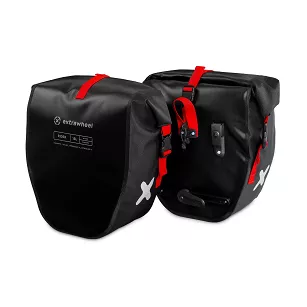
A pannier mounting system works as a complete assembly. The upper hooks carry most of the pannier's weight on the rack, while the lower retainer stabilises the bag and limits movement forwards, backwards and sideways. At the same time, the pannier body must remain safely clear of the wheel, brake, mudguard, cables and crank.
For this reason, compatibility should never be judged from a single specification such as “hooks for 6–16 mm tubes”. Tube diameter is important, but it does not by itself guarantee that the pannier will fit the rack correctly.
How to measure a bike rack before buying panniers
The most reliable approach is to take a few simple measurements before you buy. A vernier calliper is the best tool for measuring rack tube diameter, while a ruler or tape measure is sufficient for checking clear tube length and the position of rack stays.
Check the following:
- Upper rack tube diameter at the exact point where the pannier hooks will sit.
- The length of clear, reasonably straight rack tube available for both upper hooks.
- The position of rack stays, crossbars and joints that could interfere with a hook.
- The required hook spacing or the adjustment range available on the mounting rail.
- Space for the lower retainer against a vertical or diagonal rack stay.
- Clearance around the heel, wheel and brake once the pannier is fitted.
- The rack's permitted load specified by its manufacturer.
With a fixed-hook system, it is especially important to check not only whether both hooks physically fit onto the rack, but also whether a weld, joint, stay or part of the rack platform sits exactly where either hook needs to be positioned.
With adjustable hooks, compare the rack geometry with the full adjustment range of the mounting system. For example, the Rixen rail used on Extrawheel Rambler panniers allows the hooks to be positioned from 91 to 165 mm between their inner edges, while the Racktime / Tubus system used on selected Extrawheel panniers provides a considerably wider range of 55 to 220 mm.
If you are unsure about compatibility, take one photograph of the rack from the side and another from above. Add the measured tube diameter and the length of usable rack tube. This gives far more useful information for assessing fit than the bicycle or rack model name alone.
Rack tube diameter – why is the measurement alone not enough?
Rack tube diameter determines whether the upper hook can correctly engage with the rack. If the tube is too large, the hook may not close properly. If it is too small and the mounting system does not have a suitable insert or reducer, excessive play can allow the pannier to move or rattle while riding.
Measure the tube at the actual hook mounting position. Do not measure another part of the rack and assume that the entire structure uses the same diameter. Different sections of a rack may have different tube sizes, and welds or reinforced areas can also increase the effective diameter locally.
The shape of the tube also matters. Most hook systems are designed for round tubes or other profiles that remain within the dimensional limits specified by the manufacturer. An unusual tube profile may require an individual compatibility check.
Extrawheel panniers use different mounting ranges depending on the system. For example, the Rixen rail fitted to Rambler panniers is designed for rack tubes up to 12 mm in diameter. The systems used on Rider and Biker panniers are designed for tubes from 6 to 16 mm, while the Racktime / Tubus system used on Biker PRO and Wayfarer panniers is designed for rack tubes from 10 to 16 mm in diameter.
Practical rule: a compatible rack tube diameter is essential, but correct fit depends on the combination of tube diameter, clear space for the hooks and a suitable position for the lower retainer.
Fixed or adjustable hook spacing – what difference does it make?
Upper pannier hooks can either have a fixed position or be mounted on a rail that allows their spacing to be adjusted. Both systems can provide secure and stable mounting, but compatibility must be checked differently.
Fixed-position hooks
With a fixed-hook system, the hook positions are defined by the construction of the pannier. The user cannot freely slide them along the rear panel. Before buying, you therefore need to make sure that both hooks will land on clear sections of the rack tube.
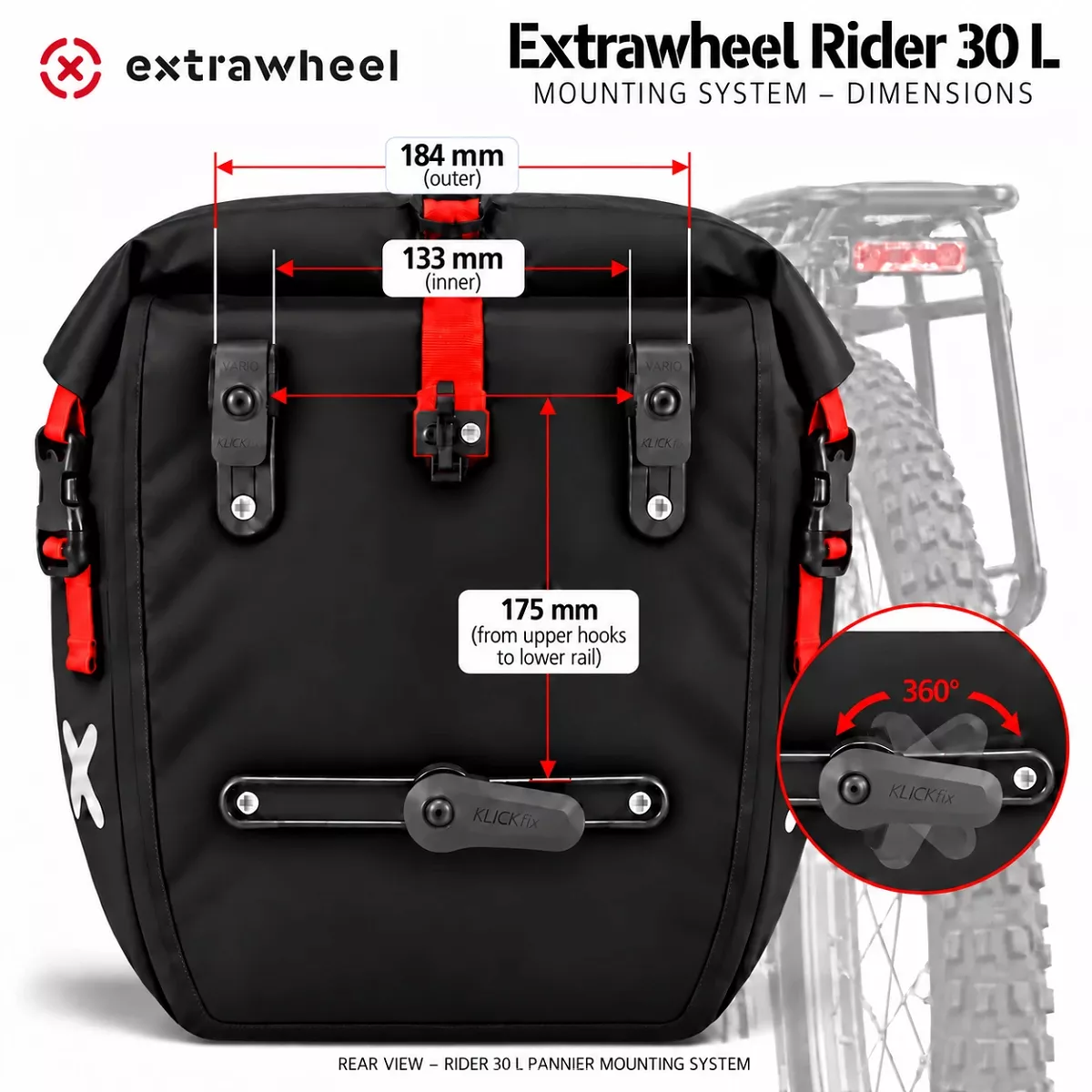
On Extrawheel Rider 30 L panniers, the distance between the inner edges of the upper hooks is 133 mm, while the distance between their outer edges is 184 mm. The vertical distance from the level of the upper hooks to the lower mounting rail is 175 mm.
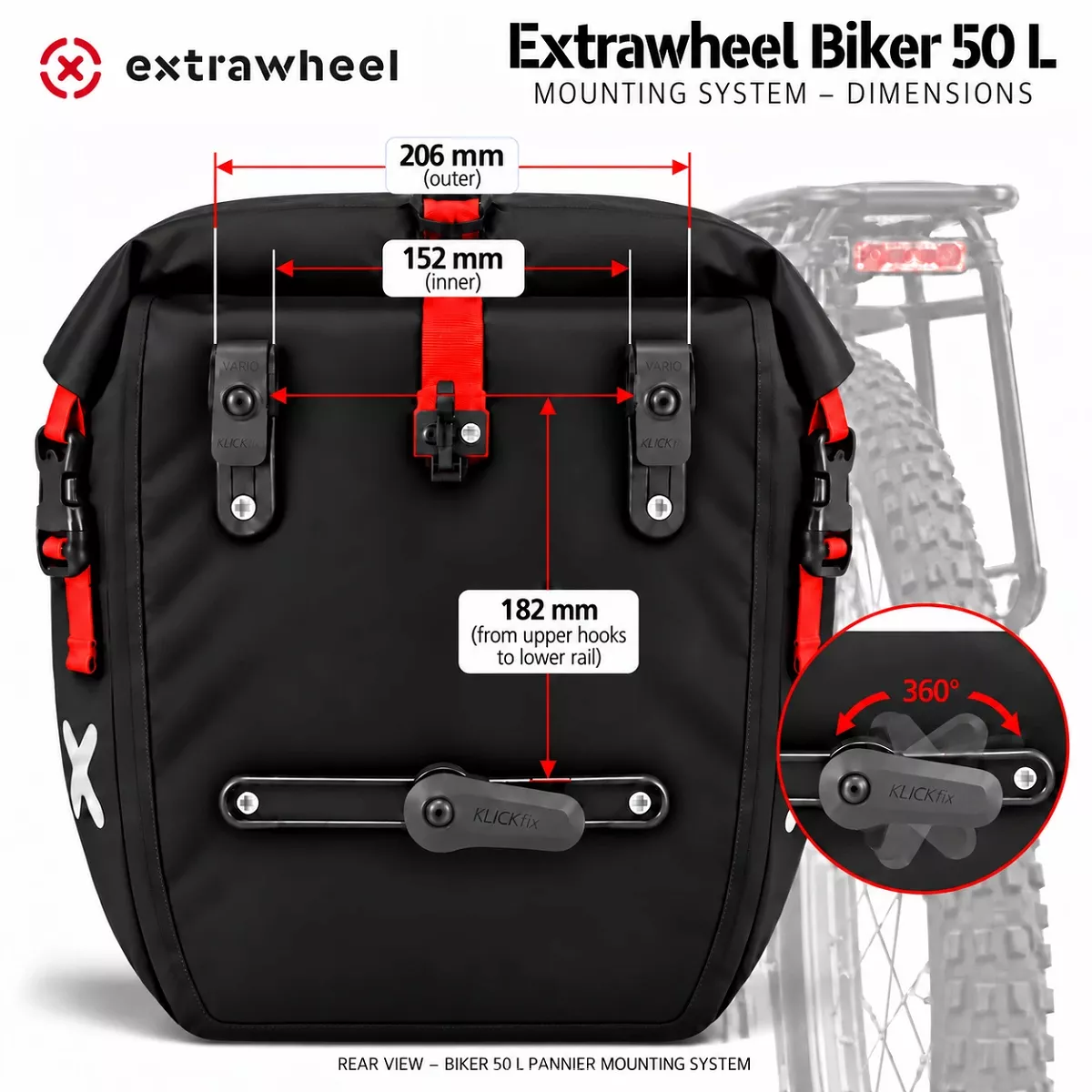
On Extrawheel Biker 50 L panniers, the corresponding measurements are 152 mm between the inner edges and 206 mm between the outer edges. The vertical distance from the upper hooks to the lower mounting rail is 182 mm.
The vertical distance between the upper hooks and the lower rail helps you determine whether the lower retainer can be positioned correctly against a side stay of the rack. This is particularly useful when checking racks with unusual geometry, where the stabilising stay may sit higher or lower than on a conventional touring rack.
It is also important to understand how these measurements are specified. Hook spacing is not measured from centre to centre. We provide separate measurements for the inner edges and outer edges of the hooks, which makes it easier to compare the mounting system with the actual usable section of the rack tube.
Hooks adjustable on a rail
An adjustable mounting rail allows the upper hooks to be repositioned, helping them avoid some rack stays and other structural elements. This can be particularly useful if the same panniers are used on several bicycles or if a rack has an unusual tube layout.
Rambler 25 L panniers use an adjustable Rixen rail. The hook adjustment range is:
- 91–165 mm between the inner edges of the hooks,
- 145–218 mm between the outer edges of the hooks.
The Rixen rail used on Rambler panniers is designed for rack tubes with a maximum diameter of 12 mm.
Biker PRO and Wayfarer panniers use the Racktime / Tubus mounting system with continuously adjustable upper-hook positioning. The available range is:
- 55–220 mm between the inner edges of the hooks,
- 100–268 mm between the outer edges of the hooks.
The Racktime / Tubus system is designed for rack tubes from 10 to 16 mm in diameter. The supplied reducer inserts allow the hooks to be correctly matched to smaller tube diameters within this range.
Adjustment does not mean automatic compatibility with every rack. You still need to check rack tube diameter, the available length of upper tube, lower-retainer position, heel clearance and any other possible points of interference.
How does the lower pannier retainer work?
The lower retainer stabilises the pannier and reduces movement while riding. The upper hooks primarily support the pannier's weight, while the lower mounting element engages with a vertical or diagonal rack stay.
A correctly positioned lower retainer:
- limits forward and backward movement of the pannier,
- reduces swinging over rough surfaces,
- helps prevent the pannier body moving towards the wheel,
- improves stability during braking and acceleration.
On many Extrawheel panniers, the lower hook can rotate through 360°, allowing its position to be matched to the direction of the rack stay.
Rotation alone, however, cannot solve every compatibility issue. The rack must provide a stable tube or stay that the lower retainer can engage with correctly. If the stay is too far away, obstructed or follows an unusual path, the fit should be assessed individually.
On models with fixed upper hooks, the vertical distance to the lower rail is another useful specification. On the Rider this distance is 175 mm, while on the Biker it is 182 mm. These measurements allow you to compare the position of the pannier's lower retainer with the side stays of the rack before installation.
Worn or damaged mounting components should be replaced. Selected hooks and service parts are available in our Extrawheel accessories and spare parts section.
How much heel clearance do you need?
There is no single universal clearance in millimetres that guarantees your heel will not touch a pannier. It depends on several factors at the same time: foot and shoe length, crank length, foot position on the pedal, frame geometry, rack position and pannier shape.
After fitting an empty pannier, rotate the crank through a complete revolution and check the position at which your heel reaches furthest towards the rear of the bicycle. Perform the test while wearing the shoes you actually use for riding.
If your heel touches the pannier, the possible solution depends on the mounting system:
- with an adjustable rail, you may be able to move the pannier further rearwards,
- the rack position may be adjustable depending on its construction,
- some bicycles may require a different rack or a pannier with different geometry.
Do not solve a heel-clearance problem by positioning the pannier in a way that prevents the upper hooks or lower retainer from working correctly. Heel clearance must never be achieved at the expense of secure mounting.
Using panniers on a bike rack with a lower pannier rail
Some rear racks have a second set of side rails positioned below the top platform specifically for mounting panniers. This can be a useful arrangement: the panniers sit lower while the top platform remains available for a dry bag, rack-top bag or other luggage.
A lower pannier rail does not automatically guarantee compatibility. Check the same parameters as you would on the upper rack tube:
- rail diameter,
- available straight section,
- position of rack stays,
- space for the lower retainer,
- clearance from the axle, wheel, brake and heel.
Lowering the pannier also reduces the distance between the bottom of the bag and the wheel or axle area. Before riding, make sure that even when fully loaded the pannier cannot move into the path of the rotating wheel.
How to choose bicycle panniers for an e-bike
Bicycle panniers can be used on e-bikes provided that the mounting system is compatible with the rack. The fact that a bicycle has electric assistance does not in itself determine whether a pannier will or will not fit.
E-bike racks do, however, more frequently include components that reduce the available mounting space, such as:
- a battery integrated into the rack,
- battery housings or guide rails,
- a battery release lock,
- electrical cables,
- integrated rear lighting,
- thicker or unusually positioned rack stays,
- an additional rack-top platform system.
A pannier should not press against the battery or cables and must not prevent access to the battery lock, charging port or battery removal mechanism.
It is also worth remembering that a rack-top platform system does not determine whether a side pannier will fit. For a pannier, the important factor is the geometry of the side tubes that carry the hooks.
On more complex e-bike racks, continuously adjustable upper hooks can provide an advantage. On Biker PRO and Wayfarer panniers, the Racktime / Tubus system allows the distance between the inner edges of the hooks to be adjusted from 55 to 220 mm, which can make it easier to avoid rack stays or other structural elements. The remaining compatibility checks still apply.
Can bicycle panniers be fitted to a front rack or lowrider?
Yes, provided that the particular pannier and front-rack combination is suitable for that use.
Smaller panniers are most commonly used on the front wheel together with a lowrider rack. Within the Extrawheel range, appropriately matched Rambler 25 L and Rider 30 L panniers can be used in this type of configuration.
On Rambler panniers, the adjustable Rixen rail provides a range of 91–165 mm between the inner hook edges and 145–218 mm between the outer edges. The system is designed for rack tubes no larger than 12 mm in diameter.
On Rider panniers, the upper-hook spacing is fixed at 133 mm between the inner edges and 184 mm between the outer edges. The distance from the upper hooks to the lower rail is 175 mm, so when fitting the pannier to a lowrider you should also check the position of the rack's side stay in relation to the lower retainer.
At the front of the bicycle, pay particular attention to:
- clearance between the pannier and tyre or rim,
- clearance from the brake caliper and brake hose or cable,
- full and unrestricted steering movement,
- the maximum permitted load of the front rack,
- balanced weight distribution between both sides.
Front luggage affects the steering directly, so the load should generally be managed more conservatively than on a conventional rear touring setup.
How to choose a bike rack if your bicycle does not have one yet
If you are building a luggage system from scratch, it can be useful to reverse the usual order: first decide what type and size of panniers you intend to use, then choose a rack that provides suitable mounting geometry.
A good bike rack for panniers should provide:
- a sufficiently long, straight section of side tube for the upper hooks,
- a tube diameter compatible with the chosen pannier mounting system,
- a side stay that the lower retainer can engage with,
- a structure that prevents the pannier moving towards the wheel,
- an adequate load rating for the intended luggage,
- a position that provides sufficient heel clearance.
If you are planning to use panniers with an adjustable rail, also check whether the rack tube layout falls within the adjustment range. For Rambler panniers, the range between the inner edges of the hooks is 91–165 mm. For the Racktime / Tubus system used on Biker PRO and Wayfarer panniers, it is 55–220 mm.
With fixed-hook systems, you should also consider the vertical position of the lower rail. On Rider panniers it sits 175 mm below the level of the upper hooks, while on Biker panniers the corresponding measurement is 182 mm.
You must also make sure that the rack itself is compatible with your bicycle, including the frame, wheel size, brakes, mudguards and available mounting points.
If the bicycle does not have conventional rack mounting points, do not assume that any adapter will solve the problem. The load capacity of the complete system is always limited by its weakest component.
Extrawheel bicycle pannier mounting systems compared
The table below summarises the key mounting-system dimensions used across Extrawheel pannier families. Hook-spacing measurements refer to the distance between the inner or outer edges of the hooks, not their centre points. For Rider and Biker panniers, we also provide the vertical distance from the upper-hook level to the lower mounting rail.
| Model | Mounting system | Rack tube diameter | Upper-hook spacing and lower-rail position | What should you check? |
|---|---|---|---|---|
| Rambler 25 L / Rambler Premium 25 L | Rixen rail – adjustable hooks | 6–12 mm | 91–165 mm inner edges / 145–218 mm outer edges | Tube diameter, rack-stay positions and compatibility with the front or rear rack |
| Rider 30 L / Rider Premium 30 L | Rixen & Kaul – fixed-position hooks | 6–16 mm | 133 mm inner edges / 184 mm outer edges; 175 mm from upper hooks to lower rail | Whether stays, welds or joints interfere with either hook and whether the lower retainer can engage correctly |
| Biker 50 L / Biker Premium 50 L | Rixen & Kaul – fixed-position hooks | 6–16 mm | 152 mm inner edges / 206 mm outer edges; 182 mm from upper hooks to lower rail | Available straight rack tube, lower-retainer position and heel clearance with a large rear pannier |
| Biker PRO 50 L / Biker PRO Premium 50 L | Racktime / Tubus – continuously adjustable hooks | 10–16 mm | 55–220 mm inner edges / 100–268 mm outer edges | Available rack tube, stays, lower-retainer position and clearance around e-bike components |
| Wayfarer 50 L / Wayfarer Premium 50 L | Racktime / Tubus – continuously adjustable hooks | 10–16 mm | 55–220 mm inner edges / 100–268 mm outer edges | Hook position, a suitable stay for the lower retainer and heel clearance |
Important: this table is intended as a first compatibility check and does not replace comparing the actual pannier with the actual rack. Even a mounting system with a wide tube-diameter range and adjustable hooks may not fit a rack with unusual geometry.
Current models, material options and detailed specifications are available in the Extrawheel bicycle panniers category.
Fixed or adjustable pannier mounting system – which is better?
There is no single pannier mounting system that is best for every rider. Fixed hook spacing can provide a simple and stable solution when the rack geometry is compatible. An adjustable rail provides more flexibility, particularly when panniers are moved between several bicycles or used with racks that have more complex tube layouts.
| Feature | Fixed hook spacing | Adjustable rail |
|---|---|---|
| Fit on one verified rack | Very good once dimensions have been checked | Very good |
| Moving panniers between different bicycles | Less flexible | Greater adjustment flexibility |
| Avoiding rack stays | Limited by fixed hook position | Easier because the hooks can be repositioned |
| Extrawheel dimensions | Rider: 133 / 184 mm, lower rail 175 mm; Biker: 152 / 206 mm, lower rail 182 mm | Rambler: 91–165 / 145–218 mm; Racktime / Tubus: 55–220 / 100–268 mm |
| Measurements required before buying | Yes | Yes |
| Guaranteed to fit every rack | No | No |
In the dimensions row, the first hook-spacing value refers to the distance between the inner hook edges and the second to the outer hook edges. For Rider and Biker panniers, the table also gives the vertical distance from the upper hooks to the lower mounting rail.
If you are choosing panniers not only by mounting system but also by capacity, material and intended use, see our complete guide to choosing bicycle panniers.
Checklist: what should you measure before buying bicycle panniers?
Before ordering panniers, work through the following checks. In most cases they will reveal a potential fitting problem before you buy.
- 1. Upper rack tube diameter: measure it with a calliper at the intended hook position.
- 2. Clear rack tube: check how much usable space remains between stays, welds and other structural elements.
- 3. Hook spacing: with a fixed system, compare the required dimensions with the rack; with an adjustable system, check whether the rail allows the hooks to be positioned where needed.
- 4. Lower-retainer position: identify a stable rack stay that the lower retainer can engage with. On fixed-hook systems, you can also compare the vertical distance between the upper hooks and lower rail.
- 5. Heel clearance: account for the actual movement of your foot throughout a full pedal revolution.
- 6. Wheel and component clearance: the pannier must not contact the tyre, brake, mudguard or cables, and it must not obscure lighting.
- 7. Load rating: compare the permitted loads of the rack, bicycle and pannier system.
If any of these points is uncertain, do not assume compatibility from the rack model name alone. A photograph with measurements is usually the most useful way to verify fit before purchase.
What should you check after fitting panniers for the first time?
Even after the dimensions have been checked correctly, the first installation should be carried out with the panniers empty.
- Hang the pannier on the upper rack tube.
- Check that both upper hooks are fully engaged.
- Position the lower retainer.
- Try moving the pannier forwards, backwards and sideways.
- Rotate the crank and check heel clearance.
- Check clearance from the tyre, mudguard, brake and cables.
- Add luggage gradually and reassess stability.
- Take a short test ride and check the mounting again afterwards.
Once the panniers are fitted correctly, weight distribution becomes equally important. Heavy items should generally be carried low and close to the bicycle. For detailed guidance, see our article on how to pack bicycle panniers properly.
How was this guide prepared?
This guide was prepared using the technical dimensions of mounting systems fitted to Extrawheel panniers, together with experience gained from designing, manufacturing, fitting and servicing bicycle touring equipment.
Extrawheel has developed bicycle touring equipment since 2005. When designing panniers, we consider not only capacity and materials, but also how the mounting system works with real-world bicycle rack geometries.
The mounting dimensions published in this guide were measured for Extrawheel pannier systems. They include upper-hook spacing and, on fixed-hook models, the distance from the upper-hook level to the lower rail: 175 mm on Rider and 182 mm on Biker. For adjustable mounting systems, we provide the minimum and maximum spacing measured between both the inner and outer hook edges, allowing a more precise comparison with the geometry of a particular rack.
General guidance does not replace the instructions for a specific bicycle or rack. If the bicycle or rack manufacturer specifies different installation or load restrictions, always follow the requirements of the individual product.
FAQ – bicycle pannier and bike rack compatibility
Do all bicycle panniers fit every bike rack?
No. You need to compare the rack tube diameter, available space for the upper hooks, hook spacing or adjustment range, lower-retainer position, heel and wheel clearance, and the rack's maximum permitted load.
How can I check whether pannier hooks will fit my bike rack?
Measure the upper rack tube diameter with a calliper, then check the length of clear tube and the position of rack stays. With fixed hooks, compare the exact hook positions with the rack structure. With an adjustable rail, check whether the required mounting points fall within the available hook adjustment range.
What is the hook spacing and lower-rail position on Extrawheel Rider panniers?
On Extrawheel Rider panniers, the distance between the inner edges of the upper hooks is 133 mm, while the distance between the outer edges is 184 mm. The vertical distance from the upper-hook level to the lower mounting rail is 175 mm. The system is designed for rack tubes from 6 to 16 mm in diameter.
What is the hook spacing and lower-rail position on Extrawheel Biker panniers?
On Extrawheel Biker panniers, the distance between the inner edges of the upper hooks is 152 mm, while the distance between the outer edges is 206 mm. The vertical distance from the upper-hook level to the lower mounting rail is 182 mm. The system is designed for rack tubes from 6 to 16 mm in diameter.
What is the hook adjustment range on Extrawheel Rambler panniers?
On Rambler panniers with the adjustable Rixen rail, the spacing can be set from 91 to 165 mm between the inner hook edges and from 145 to 218 mm between the outer hook edges. The system is designed for rack tubes with a maximum diameter of 12 mm.
What is the Racktime / Tubus hook adjustment range on Extrawheel panniers?
On the Racktime / Tubus system used on panniers including Biker PRO and Wayfarer, the distance between the inner edges of the hooks can be adjusted from 55 to 220 mm, while the outer-edge spacing ranges from 100 to 268 mm. The hooks are designed for rack tubes from 10 to 16 mm in diameter, and the supplied reducer inserts allow them to be correctly matched to smaller tube diameters within this range.
Is compatible rack tube diameter enough to guarantee that panniers will fit?
No. Tube diameter is only one requirement. A hook may coincide with a weld or rack stay, there may not be enough room for the second hook or lower retainer, or the pannier itself may interfere with your heel or the wheel.
Which is better: fixed hooks or an adjustable mounting rail?
It depends on how the panniers will be used. Fixed hook spacing works very well with a compatible rack. An adjustable rail provides greater positioning flexibility and can be more practical when using the same panniers on several bicycles or on a rack with more complex geometry.
Can bicycle panniers be fitted to an e-bike?
Yes, provided that they are compatible with the e-bike's rack. You should also check the position of the battery, cables, battery lock, lighting and rack stays. A pannier must not press against the battery or prevent it from being removed.
Does a rack-top platform mean that side panniers will fit?
No. A rack-top platform system and the side mounting system for panniers are separate issues. For side panniers, the critical factors are the geometry and diameter of the side tubes, the available hook positions and the ability to position the lower retainer correctly.
Can bicycle panniers be fitted to a front rack?
Yes, if the pannier and rack are suitable for front use. Pay particular attention to clearance from the wheel, brake and fork, full steering movement and the permitted load of the front rack.
How can I check whether my heel will hit the pannier?
Fit the empty pannier and rotate the crank through a full revolution while wearing your normal cycling shoes. Because bicycle geometry, crank length and foot size vary, there is no single minimum heel-clearance measurement that applies to every rider.
What information should I send if I am not sure whether the panniers will fit?
The most useful information is a photograph of the rack from the side, another from above, and three details: the upper rack tube diameter, the length of clear tube available for the hooks and the bicycle or rack model. With an unusual rack, it is also helpful to mark the relevant measurements directly on the photograph.
Summary: check pannier-to-rack compatibility before buying
A correctly fitted pannier should hang securely from the upper rack tube, be stabilised by the lower retainer and remain safely clear of your heel, wheel and other bicycle components. Pannier capacity, material and the stated hook-diameter range are not enough on their own to determine compatibility.
Before buying, take a few simple measurements. Check the rack tube diameter, usable hook space, rack-stay geometry, lower-retainer position and rack load rating. With fixed-hook systems, the exact hook positions and vertical distance to the lower rail are particularly important. An adjustable rail provides greater flexibility, but the complete rack geometry still needs to be checked.
Extrawheel panniers use both fixed and adjustable mounting systems. Rider has a hook spacing of 133 mm between the inner edges and 184 mm between the outer edges, with 175 mm from the upper hooks to the lower rail. On Biker, the corresponding values are 152 mm, 206 mm and 182 mm. Rambler with the Rixen rail offers an inner-edge adjustment range of 91–165 mm, while the Racktime / Tubus system used on Biker PRO and Wayfarer provides an inner-edge range of 55–220 mm.
To compare current pannier models and mounting systems, see Extrawheel bicycle panniers. For additional information about fitting, use, cleaning and servicing, see our bicycle pannier, dry bag and handlebar bag FAQ.


 Polish
 German
 French