


Which Bicycle Panniers Should You Choose? Recommended Models for Commuting and Touring
Which bicycle panniers should you choose? A 25–30 L set is usually sufficient for commuting and shorter trips, while a 40–50 L set is more practical for a multi-day bicycle tour. This guide explains which bicycle panniers are recommended for different uses and how to assess the material, waterproofing and compatibility of the mounting system with your rack.
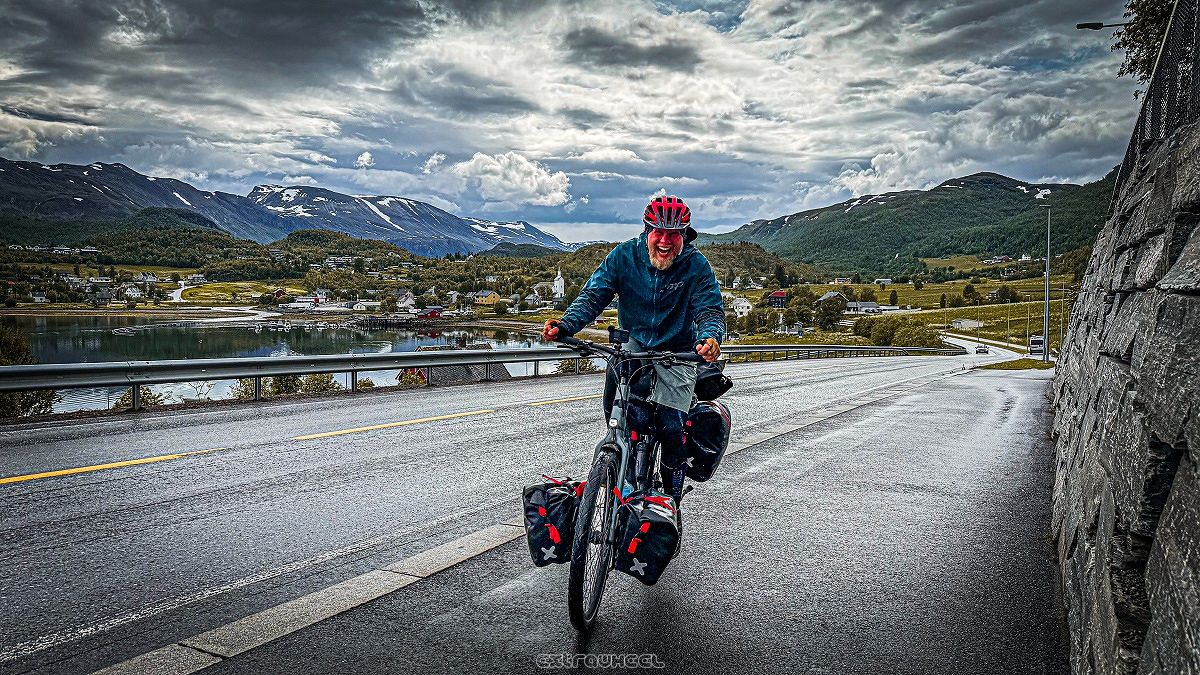
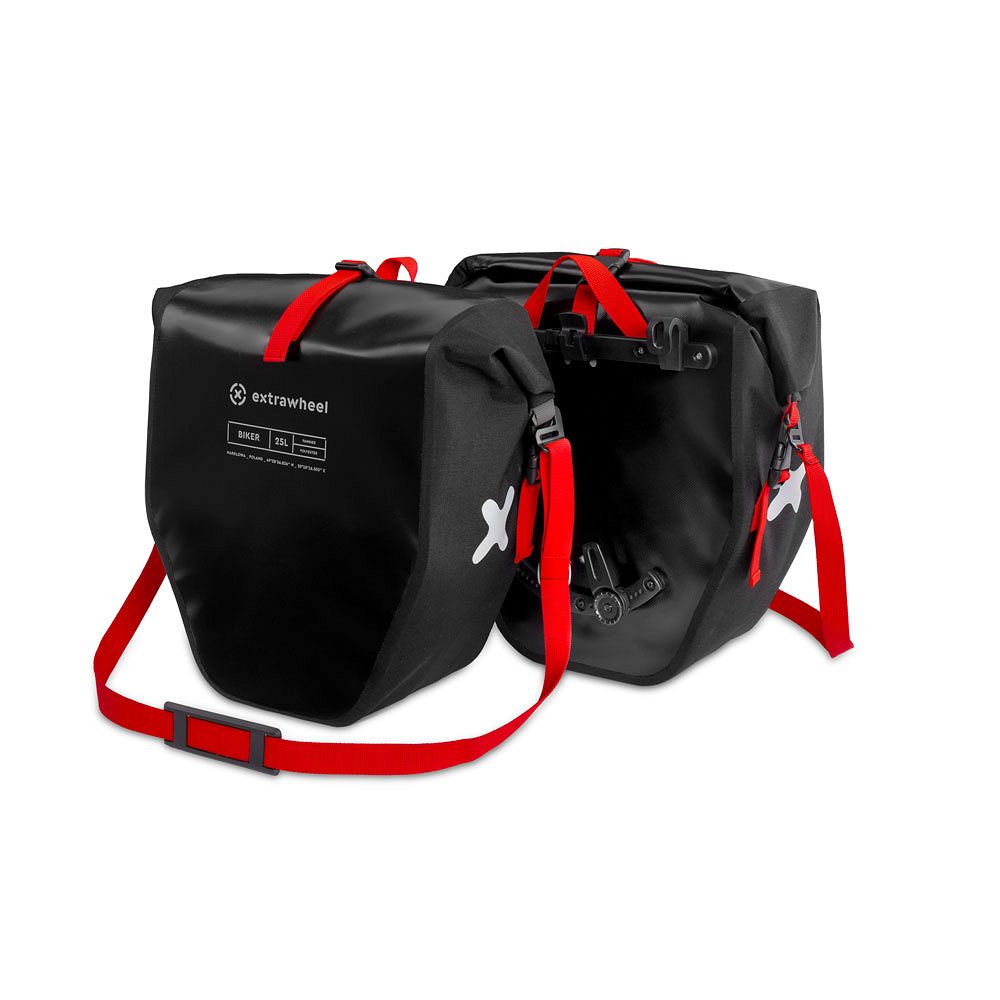
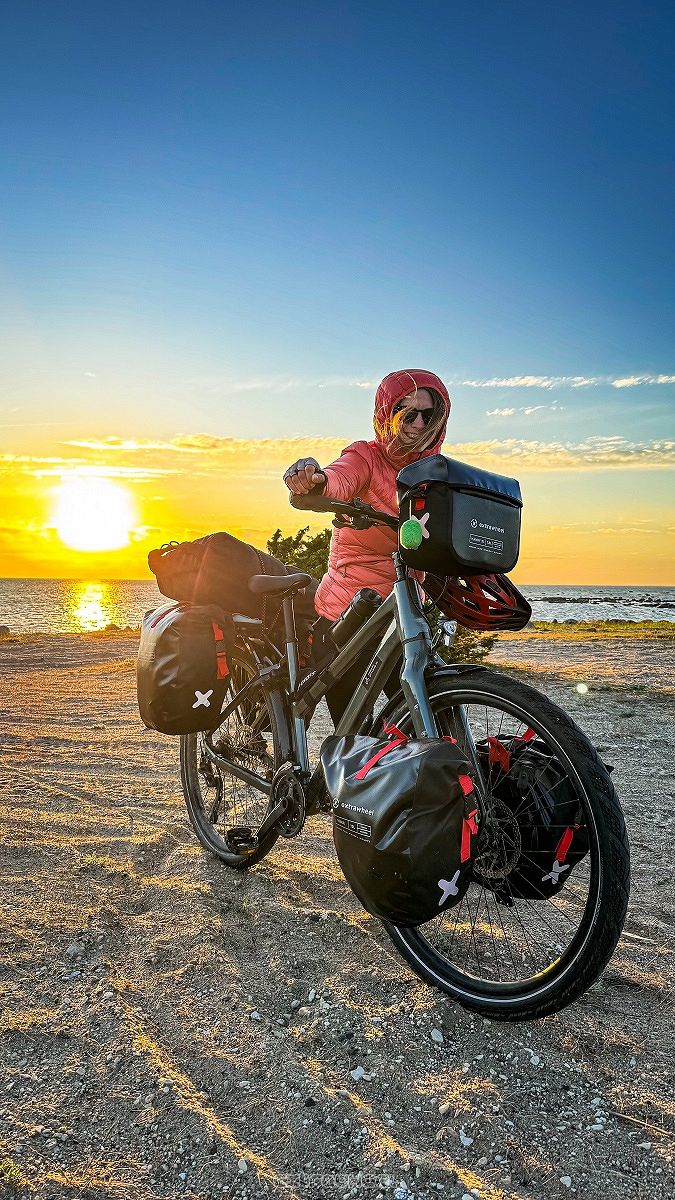
The short answer: choose panniers to match the amount of luggage, the type of rack and the length of your trip. A total capacity of 25–30 L is usually enough for everyday riding. For a tour with clothing, a sleeping bag and camping equipment, a 40–50 L set is more practical. Before buying, always check the rack tube diameter, hook spacing and how the panniers achieve waterproof protection.
Guide updated: 16 August 2026.
Which bicycle panniers are recommended?
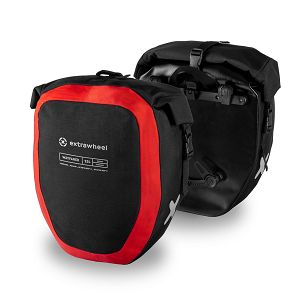
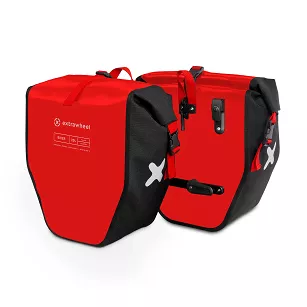
Recommended bicycle panniers should match the way you intend to use them. For commuting, shopping and shorter rides, the Extrawheel Rambler 25 L or Rider 30 L are practical choices. For a multi-day bicycle tour, the Biker 50 L is a suitable option. The Biker PRO 50 L is designed for riders who need an adjustable mounting system, while the Biker Premium 50 L is intended for cyclists looking for a lightweight Cordura set.
There is no single model that is best for everyone. A useful recommendation must take account of capacity, construction, weight, rack design and access to servicing. The table below is therefore not a ranking of brands or a list ordered from best to worst.
| User need | Recommended type | Recommended Extrawheel model | Why? | What should you check before buying? |
|---|---|---|---|---|
| Commuting, shopping and city riding | 25–30 L set | Rambler 25 L or Rider 30 L | Compact capacity without carrying a large touring set | The Rambler holds 25 L and the Rider 30 L. Both may be too small for a tour with complete camping equipment; also check that the hooks fit your rack. |
| A weekend trip with indoor accommodation | About 30 L | Rider 30 L or Rider Premium 30 L | Enough room when packing lightly | A total capacity of 30 L may not hold a tent, sleeping bag, cooking equipment and food. On the Rider, you must also compare the fixed hook spacing with your rack. |
| A first multi-day bicycle tour | Two rear panniers with about 50 L total capacity | Biker 50 L | Large capacity and HFW-welded construction | The upper hooks have fixed positions: 152 mm inner spacing and 206 mm outer spacing. Compare these measurements with your rack before purchase. |
| Using one set on different bicycles | Set with adjustable hooks | Biker PRO 50 L | Continuous adjustment of the Racktime/Tubus system makes fitting easier | The set weighs about 1.80 kg, more than the Biker Premium 50 L. Check the 6–16 mm rack tube range and the space available for the rail and hooks. |
| The lightest practical 50 L set | Cordura touring panniers | Biker Premium 50 L | Cordura, HFW welding and a set weight of about 1.35 kg | Low weight does not mean universal fitting. The upper hooks have fixed 152/206 mm spacing, so their compatibility with the rack must be checked. |
| Cordura with an adjustable mounting system | 50 L panniers with a mounting rail | Wayfarer Premium 50 L | Textile material and continuously adjustable Racktime/Tubus hooks | The set weighs about 1.98 kg and has sewn construction with protected seams. Check rack compatibility as well as the current specification and availability of the variant. |
How were these recommendations prepared?
The comparison is based on the technical data of current product families, their construction methods, Extrawheel’s manufacturing experience and the practical requirements of commuting and bicycle touring. Extrawheel manufactures the models described here, so these recommendations explain how products in its own range suit different uses; they are not an independent comparison of the entire market.
Not every “pannier” in a ranking is a touring pannier
Rankings and shopping comparison sites often place full-size rack panniers, small phone bags, saddle bags and frame bags in the same category. A 1–2 L bag cannot replace a 30–50 L touring pannier set. Before comparing prices and ratings, check the mounting position, capacity and number of items included.
Types of bicycle panniers
Rear rack panniers
Rear bicycle panniers are the most common choice for cycle touring. They provide substantial luggage capacity and let you carry equipment without loading your back. Two separate panniers make it easier to organise luggage and allow you to use only one bag for everyday journeys.
A set of about 50 L works well for trips with a tent, sleeping bag, clothing, camping equipment and food. For daily commuting, however, this capacity may be greater than you actually need.
Front panniers
Front panniers attach to a lowrider rack or another carrier designed to hold luggage beside the front wheel. They are usually smaller than typical rear panniers and can help distribute the load more evenly on a long trip.
Do not overload the front rack. Observe its rated load and make sure the pannier does not restrict steering, touch the wheel or obscure the bicycle lights.
Universal panniers for front or rear racks
Some smaller models can be used on either a front or rear rack. Examples include the Extrawheel Rider 30 L and Rambler 25 L. Before moving a pannier to a different rack, check the tube diameter, hook position and load rating of that particular rack again.
Bicycle panniers versus bikepacking bags
Traditional panniers require a rack but offer high capacity, quick removal and convenient access to luggage. Bikepacking bags attach directly to the frame, handlebar and seatpost. They are a practical option for gravel, mountain and road bicycles that cannot take a conventional rack.
Bikepacking encourages lighter packing and is well suited to off-road riding. Full-size bike panniers are more practical when you need to carry more luggage, remove it from the bicycle regularly or use the bicycle for shopping and commuting.
What bicycle pannier capacity do you need?
Manufacturers may quote the capacity of one pannier or the capacity of the complete set. A marking of 50 L (2 × 25 L) means that the set contains two 25-litre panniers. Before comparing products, make sure the stated figure refers to the same thing.
| Total set capacity | Typical use | Example luggage |
|---|---|---|
| Up to 25 L | Commuting, shopping and short rides | Jacket, tools, food and basic equipment |
| About 30 L | Commuting and weekend trips | Clothing, food, small equipment and personal items |
| 40–50 L | Multi-day bicycle touring | Clothing, sleeping bag, tent, camping equipment and supplies |
| More than 50 L | Long expeditions with additional equipment | Large rear panniers supplemented by smaller front panniers or other bags |
Do not choose the largest set solely “just in case”. Spare room encourages unnecessary packing, increases bicycle weight and may impair handling. Make an equipment list first, then choose the required capacity.
Pannier waterproofing and closure
Water protection depends on the complete construction of a pannier, not just the name of its fabric. Important factors include:
- the type of fabric and coating,
- the method used to join individual panels,
- seam protection or welded construction,
- the closure design,
- correct use in accordance with the manufacturer’s instructions.
On selected models, the panels are joined using high-frequency welding (HFW). Welds replace conventional stitching in the main construction areas and reduce the number of potential entry points for water.
The coated-polyester Biker, Rider and Biker PRO models use HFW construction. The same technology is also used in Cordura Premium versions such as the Biker Premium and Rider Premium. The Rambler and Wayfarer families, by contrast, use sewn construction with appropriately protected seams.
Full protection while riding in rain requires the top to be rolled correctly and the pannier to be fastened and compressed with its buckles as instructed. Waterproof protection in rainfall does not automatically mean resistance to prolonged submersion.
Cordura or coated polyester?
No single material is best for every use. Coated polyester and Cordura have different characteristics, so the choice should reflect riding conditions and the construction of the specific pannier.
Coated polyester fabric
Coated polyester provides a smooth surface that is easy to clean. It works well with HFW-welded construction and is practical in rain, mud and conditions where panniers need frequent washing. It is used in standard versions of the Biker, Rider and Biker PRO, among others.
Cordura
Cordura is valued for abrasion resistance, relatively low weight and a textile surface. The fabric name alone does not determine waterproofing, however. The coating, method of joining the panels and closure design also matter.
| Feature | Coated polyester | Cordura |
|---|---|---|
| Cleaning | Very easy because of the smooth surface | The textile surface requires gentler cleaning |
| Abrasion resistance | Depends on fabric thickness and coating | One of the material’s principal advantages |
| Surface character | Smooth and technical | Textile and more traditional |
| Construction method | Suitable for HFW welding | Depending on the model: protected seams or HFW welding |
How to choose a pannier mounting system
Even a durable pannier will be inconvenient if its mounting system does not fit the rack. Before buying, check:
- the diameter of the rack tubes,
- the spacing and adjustability of the upper hooks,
- the position of the rack stays and platform,
- how the lower retaining hook can be positioned,
- heel clearance while pedalling,
- the rack’s maximum load rating.
Fixed upper-hook spacing
A fixed-spacing system is simple, but its dimensions must be compared with the rack. The Biker 50 L and Biker Premium 50 L have an inner upper-hook spacing of 152 mm and an outer spacing of 206 mm. The lower hook can rotate through 360°.
The Rider also has fixed upper-hook spacing. The distance between the inner edges is 133 mm and the distance between the outer edges is 184 mm. Before purchase, check both the rack tube diameter and the free space between its stays.
Adjustable upper-hook spacing
Adjustment allows the hooks to slide along a rail. It is especially useful on e-bikes, racks with an unusual stay layout and when one set will be used on several bicycles.
The Biker PRO and Wayfarer Premium use a Racktime/Tubus system with continuously adjustable upper hooks. The Rambler uses an adjustable Rixen/KlickFix system. Adapter sets can vary between product generations, so the current product page is the definitive source for compatibility data.
Lower retaining hook
The upper hooks carry the pannier’s weight, while the lower hook limits movement and prevents the bag from bouncing away from the rack on rough surfaces. It should be positioned securely, without over-tensioning the pannier and without touching the spokes.
Extrawheel bicycle pannier comparison
The following table shows the differences between the main product families. Colour variants have the same basic purpose and are therefore not listed separately.
| Model | Capacity | Material and construction | Mounting system | Recommended use |
|---|---|---|---|---|
| Rambler / Rambler Premium | 25 L (2 × 12.5 L) | Coated polyester; Cordura on the Premium version; sewn construction | Adjustable Rixen/KlickFix | Commuting, shorter trips, front or rear rack |
| Rider / Rider Premium | 30 L (2 × 15 L) | Coated polyester or Cordura, HFW-welded | Rixen & Kaul – fixed hook spacing | Commuting, weekends, front or rear rack |
| Biker | 50 L (2 × 25 L) | Coated polyester, HFW-welded | Rixen & Kaul – fixed hook spacing | Everyday use and multi-day bicycle touring |
| Biker Premium | 50 L (2 × 25 L) | Cordura, HFW-welded; about 1.35 kg per set | Rixen & Kaul – fixed hook spacing | Lightweight cycle touring and longer trips |
| Biker PRO / Biker PRO Premium | 50 L (2 × 25 L) | Coated polyester or Cordura, HFW-welded, internal pockets | Racktime/Tubus – continuously adjustable hooks | Frequent touring and fitting different racks |
| Wayfarer / Wayfarer Premium | 50 L (2 × 25 L) | Coated polyester or Cordura, sewn construction with protected seams | Racktime/Tubus – continuously adjustable hooks | Expedition touring and adjustable fitting |
Which model should you choose?
- For commuting and shopping: the Rambler 25 L or Rider 30 L provides useful capacity without the bulk of a large set.
- For a weekend away: the Rider 30 L works with a compact packing list, especially when staying indoors.
- For a first multi-day tour: the Biker 50 L provides substantial capacity, but its fixed hook spacing must be checked.
- For riders looking for a lightweight 50 L set: the Biker Premium combines Cordura, HFW welding and a weight of about 1.35 kg.
- For use on different bicycles: the Biker PRO offers an adjustable Racktime/Tubus system and internal pockets.
- For riders who prefer Cordura and adjustable mounting: the Wayfarer Premium 50 L combines textile fabric with a Racktime/Tubus system.
- As additional front panniers: Rider or Rambler panniers can supplement a large rear set if the front rack is compatible with the mounting system and load.
Verified ratings for the Biker model
According to the figures displayed on 16 August 2026, the Extrawheel Biker 50 L product page on Allegro had a rating of 4.94/5 based on 121 verified ratings, including 43 reviews. This reflects buyer experience with this model, but it does not replace an independent comparison of products from different brands.
Common mistakes when choosing bicycle panniers
- Choosing the greatest capacity without analysing your needs. More space often results in carrying additional, unnecessary luggage.
- Checking only the rack tube diameter. You must also measure the space for the upper hooks and inspect the position of the rack stays.
- Assuming the fabric alone guarantees waterproofing. Joints, closure and correct use are equally important.
- Leaving insufficient heel clearance. A pannier positioned too far forward may interfere with pedalling.
- Confusing the capacity of one pannier with that of the pair. A 50 L label may describe a complete 2 × 25 L set.
- Distributing weight unevenly. Place the heaviest items low down and load both sides to a similar weight.
- Ignoring servicing and spare parts. Hooks and retaining components may need adjustment or replacement after several seasons.
FAQ: which bicycle panniers should you choose?
Which bicycle panniers are recommended for commuting?
Compact 25–30 L sets are recommended for commuting because they hold clothing, documents, shopping and basic tools. The Rambler 25 L suits smaller loads, while the Rider 30 L provides more room and can be fitted to a compatible front or rear rack.
Which bicycle panniers are best for a multi-day tour?
For a multi-day tour, a pair of rear panniers with a total capacity of about 40–50 L, a roll-top closure and stable mounting is usually practical. The Biker 50 L uses fixed hook spacing, while the Biker PRO 50 L has a continuously adjustable Racktime/Tubus system.
Should you choose 30 L or 50 L bicycle panniers?
A 25–30 L set is more convenient for commuting, shopping, work and shorter trips. A 50 L set is more practical for multi-day touring, particularly when carrying a sleeping bag, tent, clothing and camping equipment.
Do all panniers fit every bicycle rack?
No. Before purchase, compare the rack tube diameter, upper-hook spacing, lower-hook positioning, rack load rating and heel clearance. Adjustable hooks increase the fitting range but do not guarantee compatibility with every rack.
Is Cordura better than coated polyester?
There is no single answer for every rider. Cordura is valued for abrasion resistance, low weight and its textile surface. Coated polyester is very easy to clean and is well suited to welding. The complete pannier construction, not just the fabric name, determines its performance.
Can bicycle panniers be used individually?
Models consisting of two independent panniers can generally be mounted separately. With heavier loads, dividing luggage between both sides of the rack gives more stable bicycle handling.
Which panniers should you choose for a gravel bike?
If the gravel bike has a compatible rack, a smaller pannier set can be used while keeping weight low and preserving heel clearance. If the bicycle has no mounting points, bikepacking bags attached to the frame, handlebar and seatpost will usually be more practical.
Which panniers should you choose for an e-bike?
Choose panniers that are compatible with the particular e-bike rack and its rated load. Check the tube diameter, space occupied by the battery and cables, hook spacing, lower-hook positioning and heel clearance. Models with adjustable hooks, such as the Biker PRO 50 L or Wayfarer Premium 50 L, make it easier to fit different designs, but they are not guaranteed to suit every e-bike rack.
Bicycle panniers or bikepacking bags: which should you choose?
Bicycle panniers are practical when the bicycle has a rack and your priorities are higher capacity, quick removal and easy access to luggage. Bikepacking bags work well on bicycles without racks and for lightweight gravel or off-road riding. Panniers are usually more convenient for daily commuting and trips with more equipment; a bikepacking set may be preferable on shorter routes and rides where minimising luggage width matters.
How should you distribute luggage in bicycle panniers?
Place the heaviest items low and as close as practical to the wheel axle. Keep the weight similar on both sides and place items needed during the ride near the top. For detailed instructions, read how to pack bicycle panniers properly.
Summary: match your panniers to the trip and rack
A 25–30 L set is usually enough for commuting and shorter rides. For a multi-day trip, two rear panniers with a combined capacity of about 50 L are more practical. On very long tours, a large rear set can be supplemented with smaller front panniers.
Before buying, check the rack tube diameter, hook spacing, lower-hook position, heel clearance and how waterproof protection is achieved. Compare the current range of Extrawheel bicycle panniers and the technical data on the relevant product pages.
Author: Radoslaw Rakoczy – Extrawheel sp. z o.o.
Co-owner of Extrawheel, involved in the development and manufacture of bicycle touring equipment. This guide was prepared using the technical specifications of current models, the company’s manufacturing experience and the practical requirements of daily riding and cycle touring.
The author used earlier generations of the Wayfarer and Rambler models, among others, during a solo bicycle journey through South America. This experience is described in important information before a bicycle tour. Information about earlier generations does not replace the specifications on current product pages.
More information about the company, the history of the brand and manufacturing in Poland is available on the About Extrawheel page.
 Polish
 German
 French