


CORDURA® for Bicycle Panniers – Properties, Waterproofing and Comparison with Polyester
Why is CORDURA® considered one of the most trusted technical fabrics for bicycle panniers and outdoor luggage? In this expert guide, we explain its abrasion and tear resistance, the real meaning of 500D and 560 dtex, how waterproof performance is achieved, and how CORDURA® compares with coated polyester. Drawing on Extrawheel’s manufacturing experience, we also show why the final performance of a pannier depends on much more than the fabric name alone.
Last updated: 3 October 2026
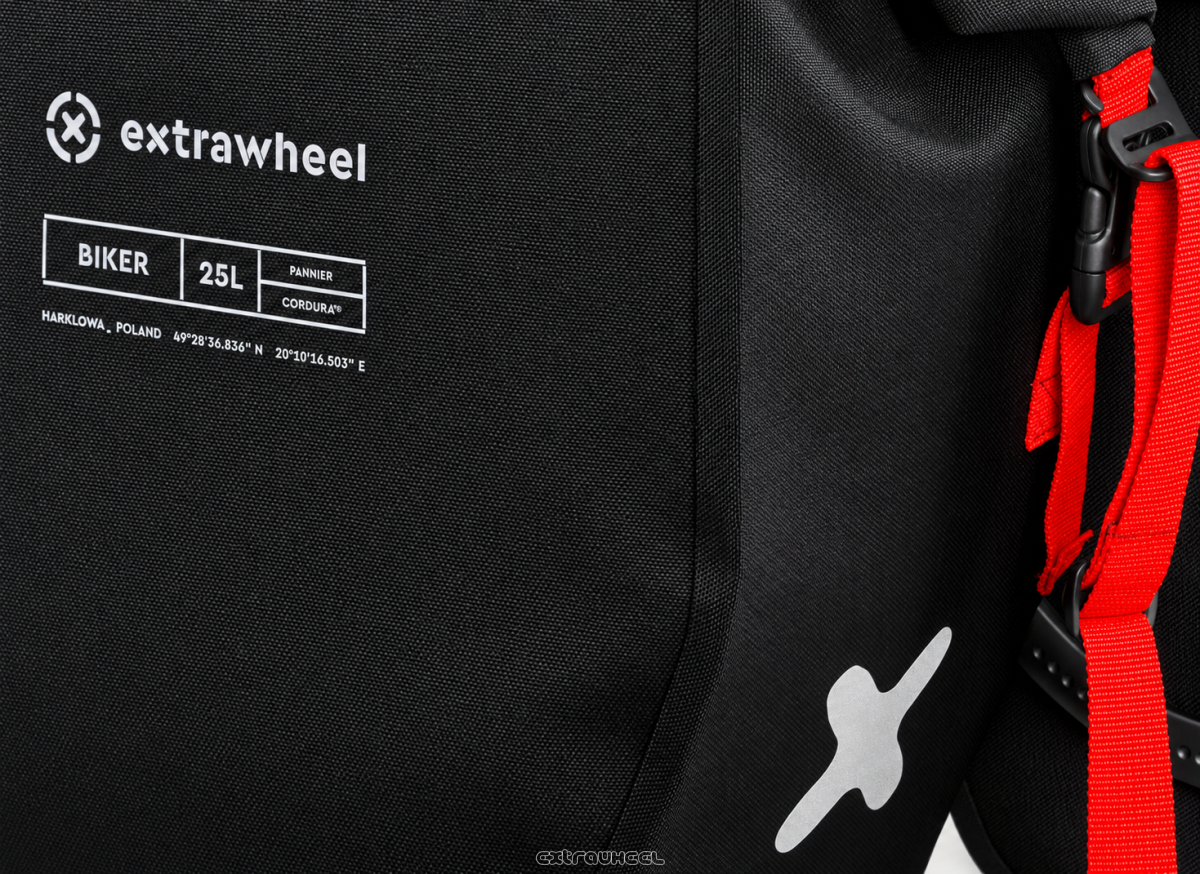
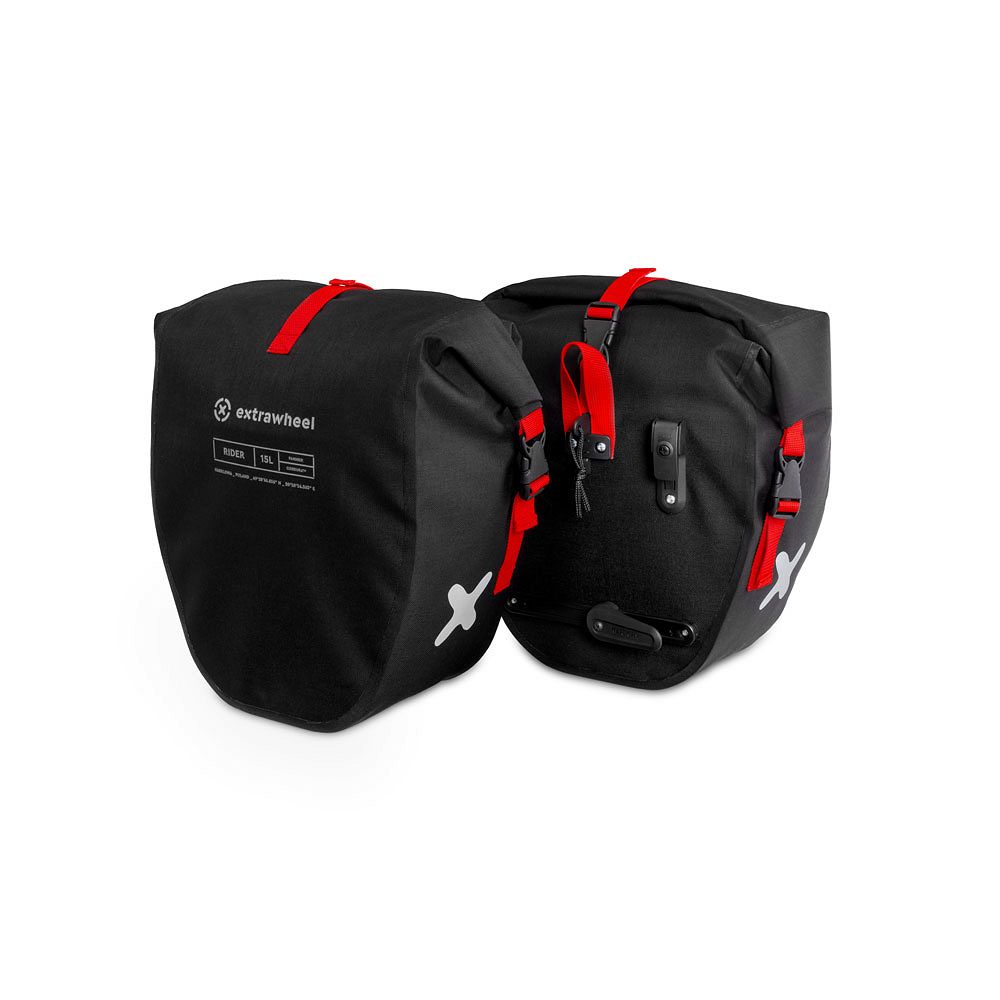
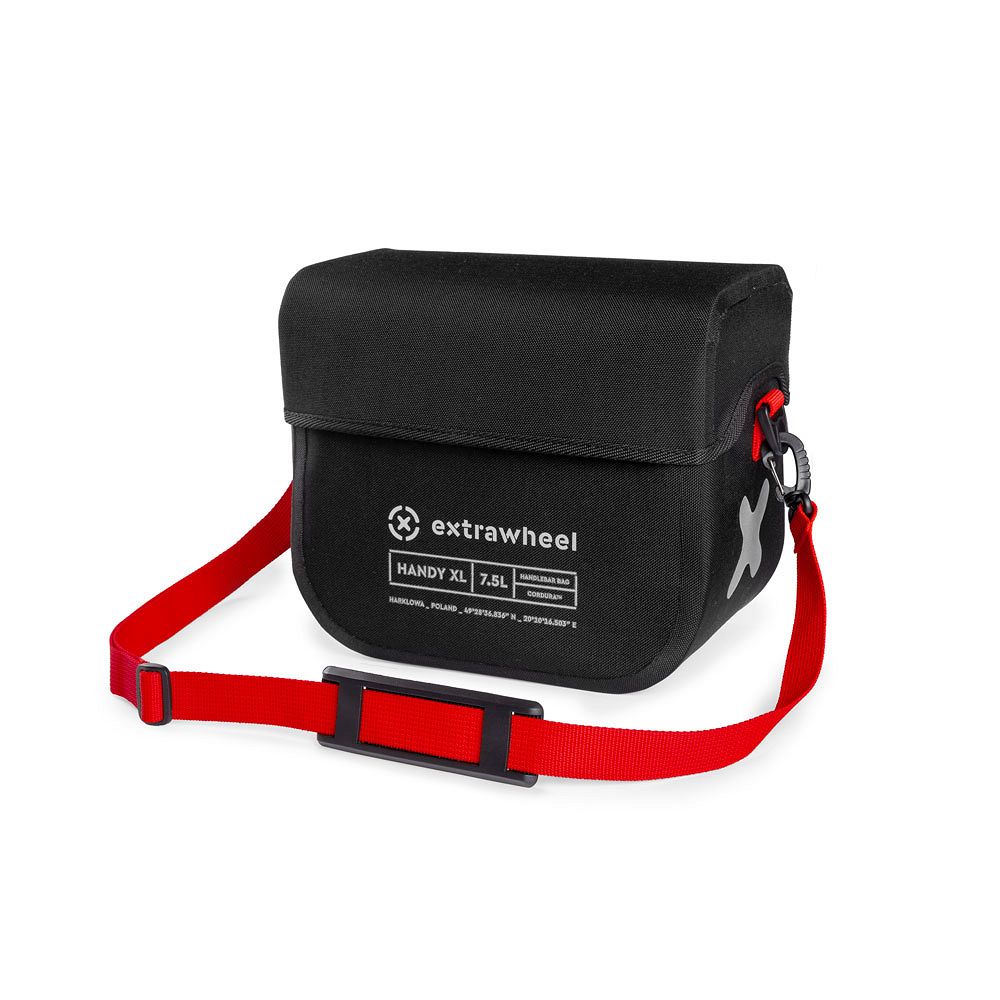
CORDURA® is one of the best-known families of technical fabrics used in backpacks, luggage, outdoor clothing and bicycle panniers. Its key advantages include high mechanical durability, particularly resistance to abrasion and tearing. However, the CORDURA® name alone does not mean that a fabric – or a pannier made from it – is automatically waterproof.
The short answer: CORDURA® can be an excellent material for bicycle panniers (bike panniers), but the performance of the finished product depends on the complete construction: the base fabric, coating or laminate, panel joining method, welded or sewn seams, mounting points and closure design.
This is why bicycle panniers should not be compared solely by the material name printed on the label. Two panniers made from fabrics belonging to the CORDURA® family may differ considerably in weight, waterproof performance, construction method and intended use.
CORDURA® at a glance
- CORDURA® is a family of technical fabrics, not one material with a single fixed specification.
- CORDURA® Classic is made from high-tenacity nylon 6,6.
- The official CORDURA® history identifies 1967 as the year CORDURA® nylon 6,6 was commercially introduced.
- CORDURA® Classic is available in 330D, 500D, 700D and 1000D constructions.
- Its key characteristics include high resistance to abrasion and tearing.
- CORDURA® alone does not guarantee waterproofness.
- Water resistance depends on the specific fabric construction, finish, coating or laminate and the design of the finished product.
- Some CORDURA® constructions can be used with 3D HFW when they incorporate a compatible thermoplastic layer.
What is CORDURA®?
CORDURA® is a brand covering a family of technical fabrics designed for applications where durability and mechanical resistance are important. These materials are used in products including backpacks, luggage, footwear, workwear, outdoor equipment and specialist gear.
One of the best-known variants is CORDURA® Classic. According to the official manufacturer specification, it is made from high-tenacity nylon 6,6 filament fibre, with air-jet textured yarns creating its characteristic textile appearance. CORDURA® Classic is available in several constructions, including 330D, 500D, 700D and 1000D.
This distinction matters because “Cordura” is sometimes used as if it were the name of one single fabric. In reality, the properties of a product should be assessed using the exact specification of the fabric, rather than the brand name alone.
CORDURA® history – why is 1967 important?
The official CORDURA® history identifies 1967 as the year CORDURA® nylon 6,6 was commercially introduced.
Over the following decades, the product family was developed and expanded for applications including outdoor equipment, luggage, workwear and specialist products.
Modern CORDURA® should therefore not be understood as one fabric that has remained unchanged for decades. It is a continually developed family of materials that can differ in fibre type, weave, weight, finish, coating, laminate and intended application.
Why does CORDURA® work well in bicycle panniers?
Bicycle panniers operate in demanding conditions. They are repeatedly mounted and removed, loaded, rolled, compressed by straps and exposed to continuous vibration while riding. Their surfaces may also come into contact with dust, mud, branches and rough ground.
For this reason, a pannier material should perform well when exposed to:
- abrasion and repeated friction,
- tearing initiated by local damage,
- repeated folding and flexing,
- loads created by carried luggage,
- long-term use in changing conditions.
High abrasion resistance and good tear resistance are among the principal characteristics associated with CORDURA® Classic. This makes appropriately selected CORDURA® fabrics particularly suitable for luggage and bicycle touring equipment.
This does not mean that every CORDURA® fabric will automatically outperform every polyester fabric. The correct comparison is always between specific materials, their technical parameters and the construction of the finished pannier.
Is CORDURA® waterproof?
No. The CORDURA® name alone does not mean that a fabric is waterproof.
This is one of the most important distinctions when selecting materials for bicycle panniers. The base fabric primarily provides mechanical strength. A separate coating or laminate can provide the barrier that limits water penetration.
Waterproof performance of the finished pannier also depends on:
- the construction and properties of the fabric,
- the type of coating or laminate,
- the integrity of panel joins,
- welded joins or appropriately protected seams,
- mounting points for hooks and other components,
- the construction of the base and corners,
- the closure system,
- the condition of the product and correct use.
Two bicycle panniers made from materials carrying the CORDURA® name can therefore perform very differently during prolonged rain.
We explain this subject in more detail in our guide What Makes Bike Panniers Waterproof? How to Keep Your Gear Dry.
Water-resistant fabric and a waterproof pannier are not the same thing
A parameter measured on a fabric sample should not automatically be attributed to the complete finished product.
A fabric may resist water penetration very effectively while a completed pannier still contains potential leakage paths through seams, mounting holes or an incorrectly closed roll-top. Conversely, a textile outer surface becoming wet does not necessarily mean that water has passed through to the inside.
The fabric, the joint and the finished product are three different levels of evaluation. Testing one of them should not be presented as proof of the performance of the others.
We apply the same principle when evaluating Extrawheel materials and finished products. More information is available in Extrawheel Quality and Durability – Materials, Testing and Manufacturing in Poland.
CORDURA® 500D, 1000D and 560 dtex – what do these numbers mean?
Values such as 500D and 1000D describe the linear mass density of the yarn.
The letter D stands for denier. One denier represents one gram of mass per 9,000 metres of yarn.
European technical specifications also frequently use dtex – decitex. One dtex represents one gram per 10,000 metres of yarn.
The conversion is approximately:
1 dtex ≈ 0.9 denier.
This means that 560 dtex corresponds to approximately 504D, making it broadly comparable with a 500D yarn class.
Denier should not, however, be confused with fabric thickness, fabric weight or the strength of the finished textile. Performance also depends on:
- fibre type,
- fibre strength,
- weave construction and density,
- fabric weight,
- surface finish,
- coating or laminate,
- processing technology,
- intended application.
Is CORDURA® 1000D better than 500D?
Not necessarily. A higher denier value is not a universal measure of quality.
A heavier 1000D construction may be appropriate where extremely high mechanical resistance is required. In bicycle panniers, however, designers must also consider product weight, flexibility, formability and the joining technology used.
The correct engineering approach is therefore not simply to choose the heaviest available fabric. The material should be selected according to the intended use and expected loads.
CORDURA® vs coated polyester – which is better for bicycle panniers?
There is no single material that is best for every cyclist. Both CORDURA® and coated polyester can be excellent choices for bicycle panniers, but they offer different practical characteristics.
| Feature | CORDURA® | Coated polyester |
|---|---|---|
| Surface character | Usually more textile-like | Usually smoother |
| Abrasion resistance | One of the key strengths of appropriately selected CORDURA® fabrics | Depends on the base fabric, construction and coating |
| Tear resistance | High in suitable CORDURA® constructions | Depends on the specific fabric and construction |
| Protection from water | Depends on the coating or laminate and complete pannier construction | Depends on the coating and complete pannier construction |
| Cleaning | A textile outer surface may require more thorough cleaning | A smooth coated surface is usually easier to wipe clean after muddy rides |
| 3D HFW welding | Possible with a suitable thermoplastic layer | Possible with a compatible thermoplastic coating |
| Weight | Depends on the exact material construction | Depends on the exact material construction |
| Appearance | Textile, technical appearance | Smoother, technical appearance |
For cyclists who regularly ride in muddy conditions and clean their panniers frequently, a smooth coated polyester surface can be particularly practical. Riders who prefer a textile surface and place a high priority on abrasion resistance may prefer a CORDURA® construction.
The more useful question is therefore not simply “CORDURA® or polyester?”, but rather: which material and pannier construction best match the way I intend to use the product?
If you are still choosing the right size and construction, see our guide Which Bicycle Panniers Should You Choose?.
Are CORDURA® bicycle panniers lighter?
There is no universal rule.
CORDURA® is available in many constructions and fabric weights, just as polyester fabrics are. The final weight of a pannier depends on the base fabric, coating or laminate, number of panels, mounting system, reinforcements, pockets and other components.
A lightweight CORDURA® pannier can therefore be designed, but the material name alone does not automatically mean that the finished product will weigh less.
Can CORDURA® be welded using 3D HFW?
Yes, but not every CORDURA® construction is suitable for high-frequency welding.
In HFW, the important factor is the thermoplastic layer incorporated into the fabric or laminate. It must respond correctly to the high-frequency electromagnetic field and allow a durable joint to form under energy and pressure.
A more technically accurate statement is therefore:
“A suitably engineered CORDURA® material with a compatible thermoplastic layer can be used in products joined using 3D HFW.”
The CORDURA® name alone should not be taken as proof that a particular fabric can be welded using this process.
We explain the technology in detail in HFW Welding in Bicycle Panniers – How It Works and Why It Matters.
Why is the fabric only one part of a bicycle pannier?
From a manufacturer’s perspective, selecting a high-quality fabric is only the starting point.
A pannier design must balance mechanical durability, weight, protection from water, fabric formability, manufacturing technology and the mounting system.
Factors that have to work together include:
- base-fabric construction,
- coating or laminate type,
- material behaviour during welding or sewing,
- base and corner geometry,
- location of high-load areas,
- installation of hooks and rails,
- roll-top closure design,
- repeatability of the manufacturing process.
This is why two products made from fabrics carrying the same material brand can perform very differently in real-world use.
CORDURA® in Extrawheel bicycle panniers
Extrawheel uses CORDURA® in selected Premium pannier constructions manufactured in Poland. We select materials according to the specific product design and manufacturing technology rather than assuming that one fabric is the best choice for every model.
Depending on the construction, our products include both 3D HFW-welded constructions and sewn constructions with appropriately protected seams.
This allows the manufacturing technology to be selected for the properties of the material and intended function of the product, rather than forcing every pannier into one manufacturing method.
More information about material selection, technological trials, testing and long-term product experience is available in Extrawheel Quality and Durability.
What does the CORDURA® name not tell you about a pannier?
The use of a recognised technical fabric is useful information, but it does not replace a complete product specification.
The CORDURA® name alone does not tell you:
- whether the finished pannier is waterproof,
- the exact construction of the fabric,
- the coating or laminate used,
- the waterproof performance of the complete product,
- how the panels are joined,
- whether the pannier is sewn or welded,
- the finished product weight,
- the quality of the mounting system,
- whether the pannier is designed for immersion,
- how durable the complete product will be in real-world use.
When choosing bicycle panniers, it is therefore better to assess the complete construction rather than the material name alone.
How should CORDURA® bicycle panniers be cared for?
Care instructions should always follow the recommendations for the specific finished product. As a general rule for bicycle panniers:
- remove mud and dust with a damp cloth, sponge or soft brush,
- avoid aggressive detergents and solvents that could damage the coating or laminate,
- leave the pannier open until completely dry after cleaning,
- inspect the lower areas and points closest to the rack regularly,
- make sure the pannier cannot rub against the wheel, tyre, brake rotor or sharp bicycle components,
- before a long tour, inspect the fabric, mounting components, joins and closure.
When should you choose CORDURA® bicycle panniers?
CORDURA® panniers are particularly worth considering when your priorities include:
- high resistance to abrasion,
- frequent and long-term use,
- a textile outer surface,
- a favourable durability-to-weight balance in a specific design,
- a technical textile appearance.
For long-distance touring, however, fabric should not be the only selection criterion. Capacity, mounting-system compatibility, rack-tube diameter, hook adjustment, pannier geometry, closure design, weight and access to service and spare parts are also important.
FAQ – CORDURA® in bicycle panniers
Is CORDURA® waterproof?
The CORDURA® name alone does not mean that a fabric is waterproof. Resistance to water penetration depends on the specific fabric construction and the coating or laminate used. In a finished pannier, welded joins or protected seams, mounting points and the closure design also affect waterproof performance.
Is CORDURA® nylon?
CORDURA® is a family of technical fabrics rather than one single textile. CORDURA® Classic is made from 100% high-tenacity nylon 6,6 filament fibre. Other materials within the CORDURA® family should be evaluated according to their individual technical specifications.
What do 500D and 560 dtex mean?
500D and 560 dtex describe the linear mass density of the yarn, not the thickness or waterproofness of the finished fabric. 500D means 500 grams per 9,000 metres of yarn, while 560 dtex means 560 grams per 10,000 metres. 560 dtex is approximately equivalent to 504D.
Is CORDURA® 1000D better than 500D?
Not necessarily. A higher denier means greater linear yarn mass, but it is not a universal measure of quality. Fibre type, weave, fabric weight, coating or laminate and intended use also affect performance. In bicycle panniers, a heavier fabric is not always the best engineering choice.
CORDURA® or coated polyester – which should I choose for bicycle panniers?
Both can perform very well in bicycle panniers. CORDURA® is particularly valued for abrasion and tear resistance and its textile surface. Coated polyester usually has a smoother surface that can be easier to clean. The best comparison considers the complete pannier construction, weight, manufacturing method and intended use rather than the material name alone.
Summary – is CORDURA® a good material for bicycle panniers?
Yes. Properly selected CORDURA® can be an excellent material for bicycle panniers, particularly where abrasion resistance, tear resistance and durability during intensive use are important.
The CORDURA® name should not, however, be treated as an automatic guarantee of waterproofness or of the quality of the complete product.
The performance of a finished pannier is created by several elements working together:
base fabric + coating or laminate + product design + joining technology + closure + mounting system + manufacturing quality.
When choosing bicycle panniers, it is therefore worth evaluating the complete construction. The fabric is the foundation, but the way all elements work together ultimately determines how the pannier performs over years of use.
Technical sources
CORDURA® Classic Fabric – official material information. Technical information covering 100% high-tenacity nylon 6,6 filament fibre, 330D, 500D, 700D and 1000D constructions, abrasion and tear resistance, and available finishes, coatings and laminates.
About CORDURA® – official brand history. Source covering the development of the CORDURA® brand and the commercial introduction of CORDURA® nylon 6,6 in 1967.
Extrawheel – technical documentation and manufacturing experience. Product-development knowledge relating to bicycle pannier construction, materials, 3D HFW, sewing, protected joins and product testing.
About the author
Radosław Rakoczy – co-owner of Extrawheel, involved in the development and manufacture of bicycle panniers and bike bags, technical-material selection, 3D HFW development, mounting systems and equipment for bicycle touring.
 Polish
 German
 French