


Bornholm by Bike with Panniers – Route 10 Around an Island Made for Cycling
Explore Bornholm by bike with panniers in two days on a 122 km loop created and ridden by Aleksandra and Daniel Sienkiewicz of Loverowi. Their route follows Danish Cycle Route 10 for most of the way. The authors describe the course and surfaces, the most interesting sights, an overnight stay in a shelter, and the bicycle panniers and touring equipment tested during the trip. This guide will help you plan your own cycling tour of Bornholm.
Why cycle around Bornholm?
For years, Bornholm has been a popular foreign destination among Polish cyclists and an attractive touring island for riders from across northern Europe. The journey now requires a little more logistical planning than it once did, but Bornholm remains an excellent place for an adventure with bicycle panniers – including a tent and nights spent close to nature.
Denmark has provided the island with excellent cycling infrastructure. Well-prepared cycle routes cross Bornholm, and characteristic wooden shelters and designated campsites can be found along the way. Even in season, the island does not usually feel excessively crowded, so you can enjoy the ride and scenery without the congestion found on many better-known routes.
Our proposal is a two-day tour based on the official Cycle Route 10, which runs around the island. We leave the main route several times to visit some of Bornholm’s most interesting places. If you have more time, the itinerary can easily be extended.
According to the official description of Route 10, Bornholm Rundt, the standard loop is 104.5 km long. Our version covers 122.1 km because it includes additional rides to attractions located away from the main route. It starts and finishes in Rønne and circles the island clockwise.
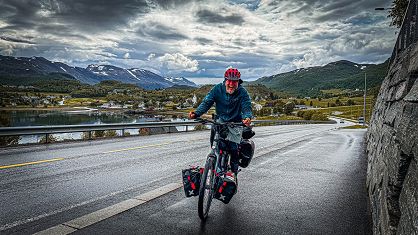
Do not be misled by the island’s modest size: Bornholm can be tiring. Unlike flat Öland, it has several demanding climbs, including one that is impressively steep. The wind can also make progress considerably harder, and island weather can change quickly.
In return, Bornholm offers remarkable variety: medieval churches and historic sites, cliffs, forests and beaches, picturesque harbours and local food. Almost all these places can be reached on nearly any bicycle, as the surface is not generally a major obstacle.
Denmark can be expensive, so budget-conscious travellers may want to carry a modest food supply. Apart from that, all that remains is to pack the panniers and set off on an island adventure. Bornholm is undoubtedly best discovered on two wheels.
How to reach Bornholm with a bicycle
One of the most convenient international options is to travel to Ystad in southern Sweden and take the ferry from Ystad to Rønne. The crossing takes about 80 minutes. Travellers coming through Denmark can also reach Ystad via Copenhagen and Malmö, while other ferry options may operate depending on the season and timetable. Before departure, check the current Bornholmslinjen ferry timetable and the connections needed to reach the departure port.
Remember to add your bicycle when booking the ticket. Allow enough time for transfers, particularly if separate operators are involved.
Along the coast – first impressions of cycling Bornholm
After arriving on Bornholm, you reach Rønne, the island’s largest town and a natural starting point for a cycling tour. It is worth stocking up here and taking a short walk through the town before setting off.
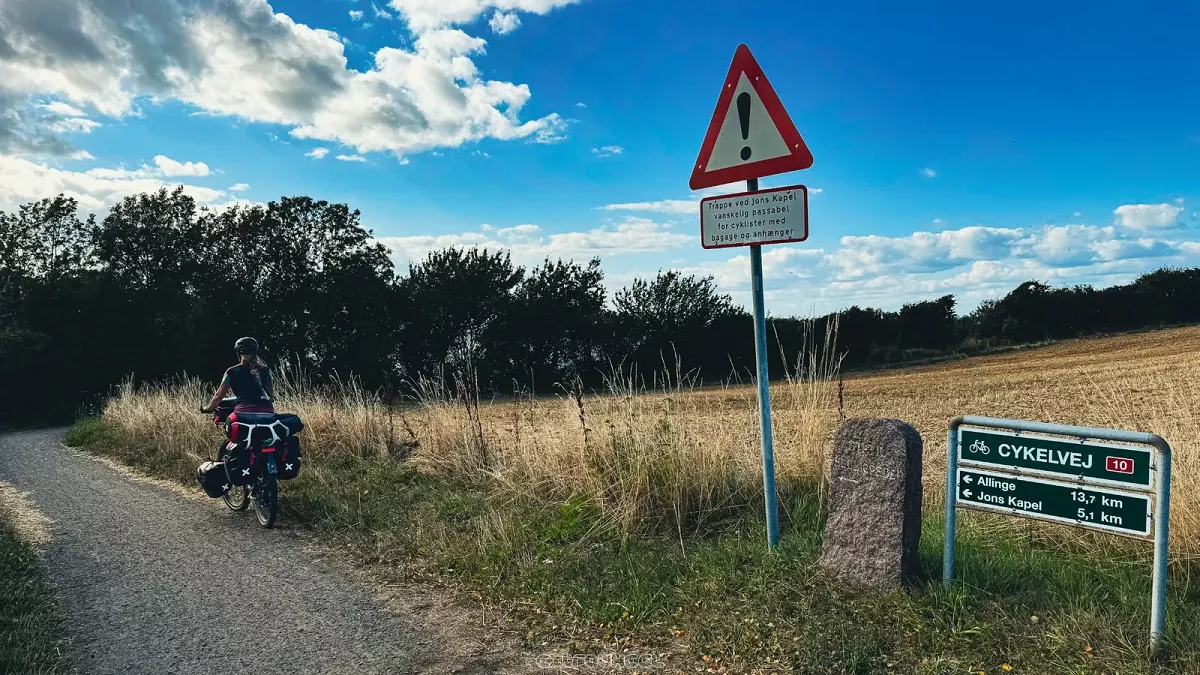
Ahead lies Cycle Route 10, also known as Bornholm Rundt. This official route circles the island and connects its principal coastal towns, including Hasle, Allinge, Gudhjem, Svaneke, Nexø and Dueodde.
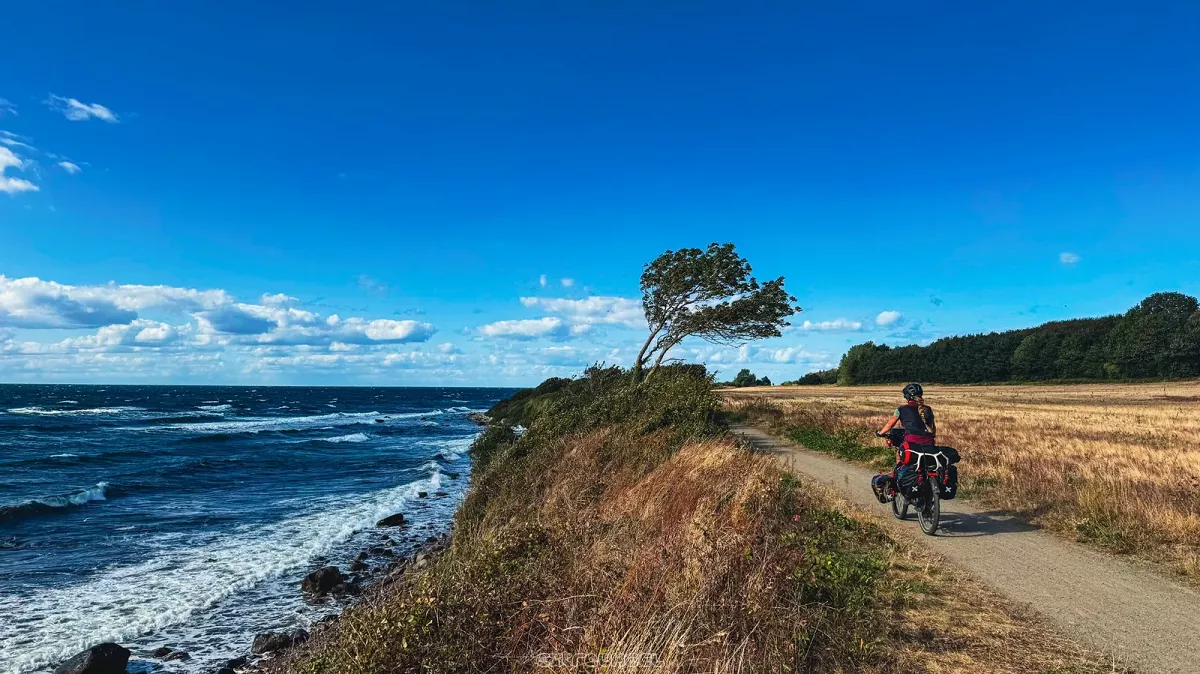
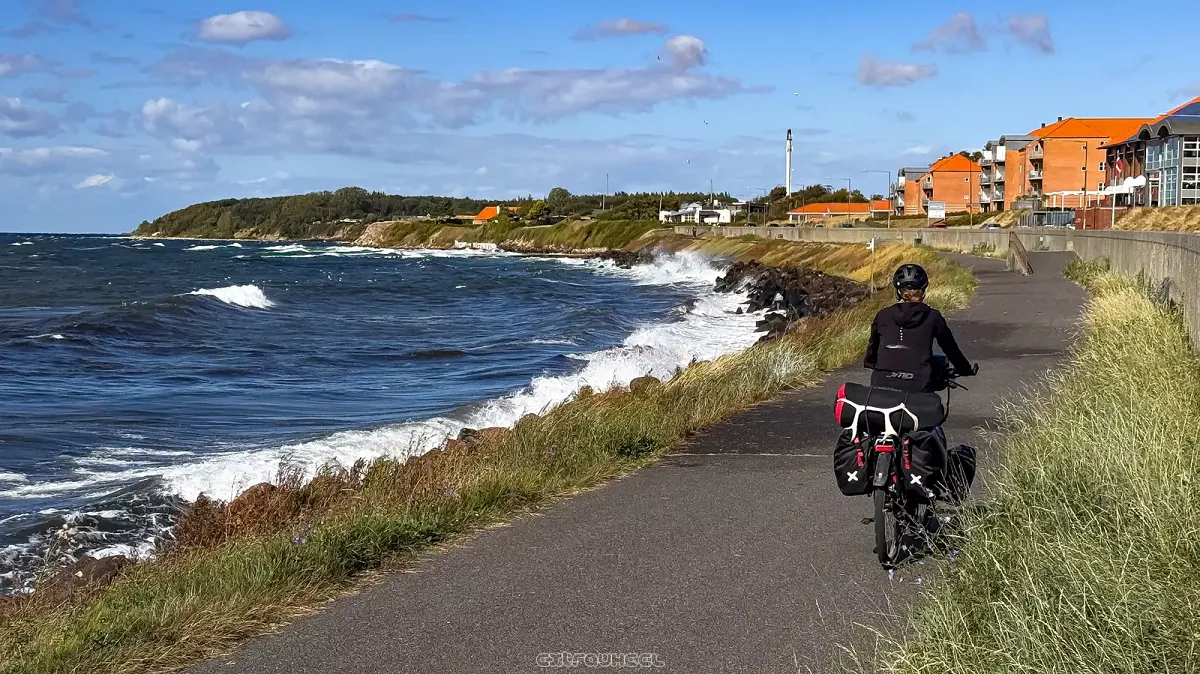
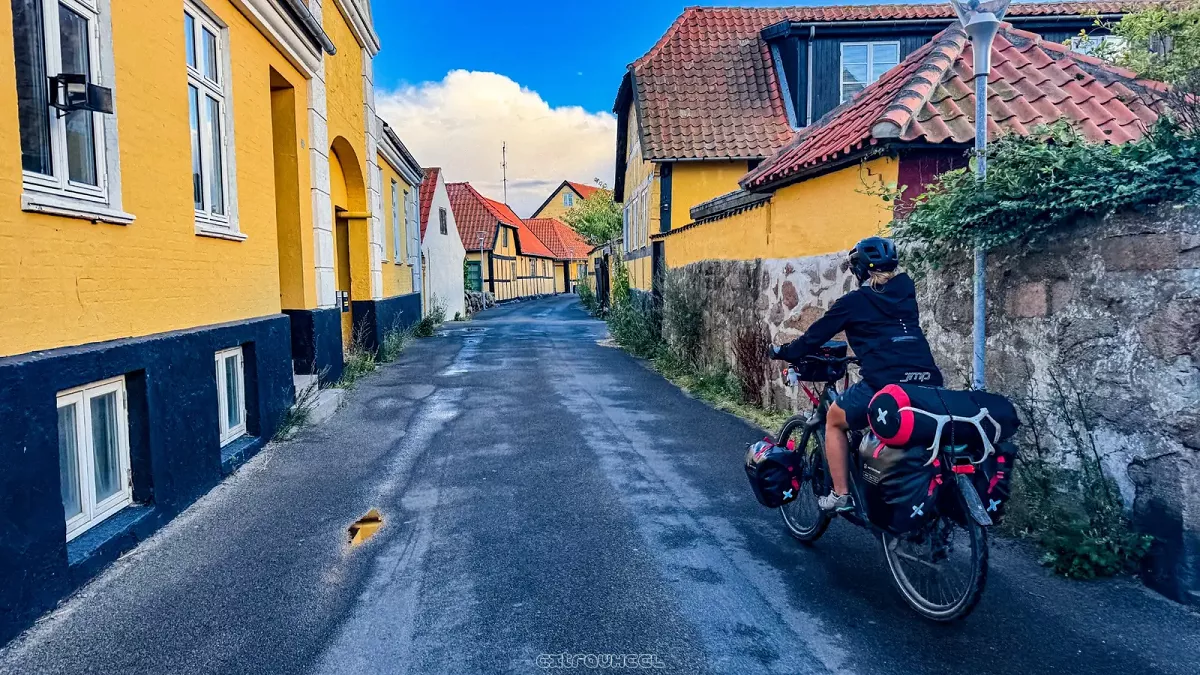
One of the route’s greatest strengths is its changing scenery. At times you ride beside the Baltic Sea; elsewhere you enter a forest or pass small harbours and seaside settlements. The western and northern coasts are rockier and hillier, while the south becomes calmer and flatter. In the north, you should also expect gravel and forest sections.
The route includes plenty of striking places. One is Jons Kapel, an approximately 40-metre cliff on the west coast with a natural cave at its foot. It is one of Bornholm’s most distinctive rocky landmarks.
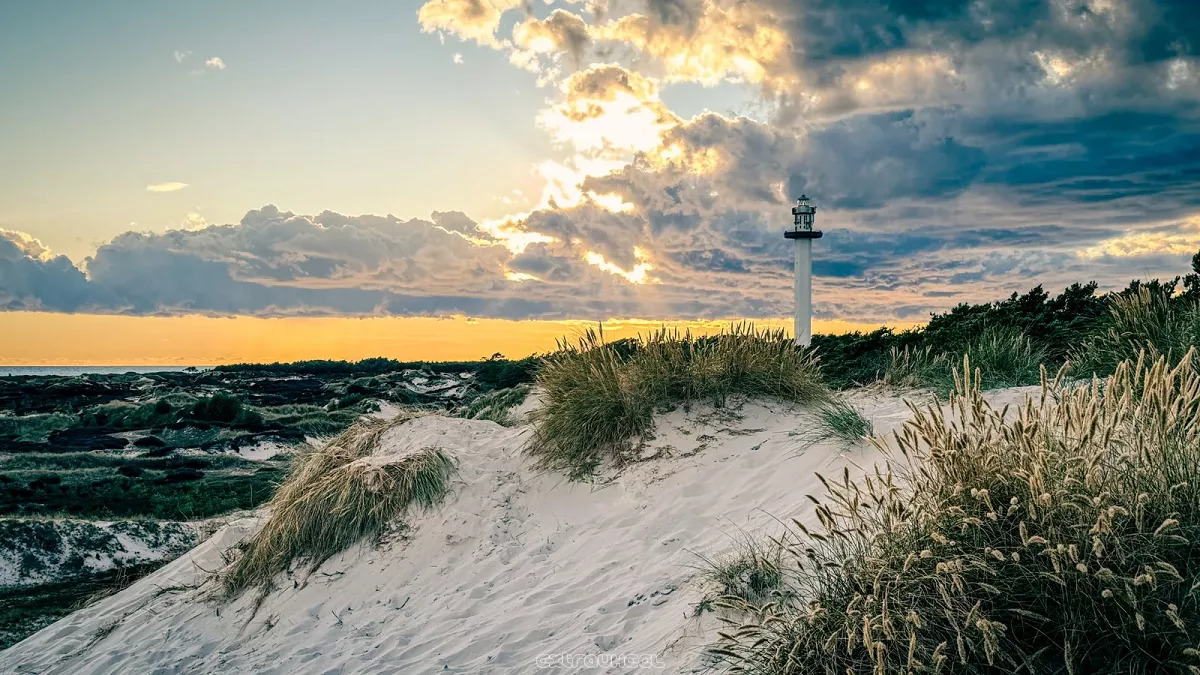
The island’s southern tip has a completely different character. Dueodde has a broad sandy beach bordered by dunes and pine forest. Its unusually fine sand was once used in hourglasses. Overlooking the area is Dueodde Fyr, Bornholm’s tallest lighthouse, which stands 47 metres high.
Bornholm is best explored without rushing. Route 10 can be completed in a single day, but dividing it into several stages is far more enjoyable. That leaves time not only to cover the kilometres but also to visit beaches, harbours, viewpoints and the island’s quieter corners.
Bornholm’s rural character
Although Bornholm is associated mainly with the sea, cliffs and cycle routes, its landscape also has a distinct agricultural character. Turn inland for a while and the sound of the Baltic gives way to farms, pastures, fields and animals.
Among the more memorable sights are Galloway cattle, a distinctive long-haired breed well suited to grazing open land.
Rural Bornholm can also surprise in less obvious ways. Lille Gadegård in Pedersker is one of the island’s larger vineyards and was established in 1995. It produces wine and other drinks, and visitors can also see animals at the farm.
Its most unusual resident is the famous pig Øffe, known as the “cola pig”. During organised tours, visitors may see the animal drinking cola. Well, everyone does what they can to win customers…
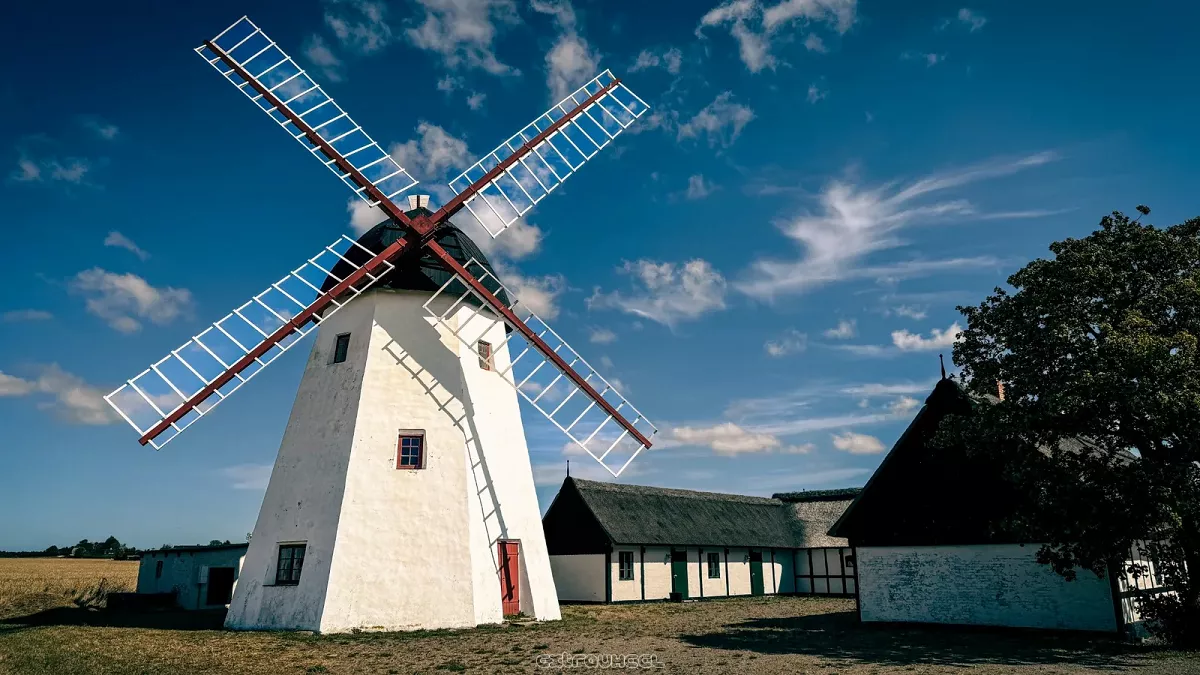
Another worthwhile stop is Årsdale Mølle, a historic windmill near Svaneke. Built in 1877, it still has working mechanisms and sails that can be turned. Although flour production has ended, the mill can be visited inside, where its preserved machinery illustrates traditional grain milling. The building is also listed in Denmark’s register of historic monuments.
Places like these reveal a less obvious side of Bornholm. Beyond the coastal cliffs and popular beaches lies an island where farming, milling and small rural communities played an important role for centuries. It is worth leaving the main route occasionally and looking more deeply into the Bornholm landscape.
Top attractions on Bornholm
Cycling is not the only reason to visit Bornholm. This is an island where it pays to get off the saddle occasionally and swap a full water bottle for a camera.
One of the route’s major landmarks is Hammershus, the impressive ruins of a medieval fortress on the north-west coast. Built in the 13th century, the castle served important military and administrative functions for centuries. Its remains now occupy a rocky plateau high above the Baltic, and the nearby visitor centre includes a terrace with a broad panorama.
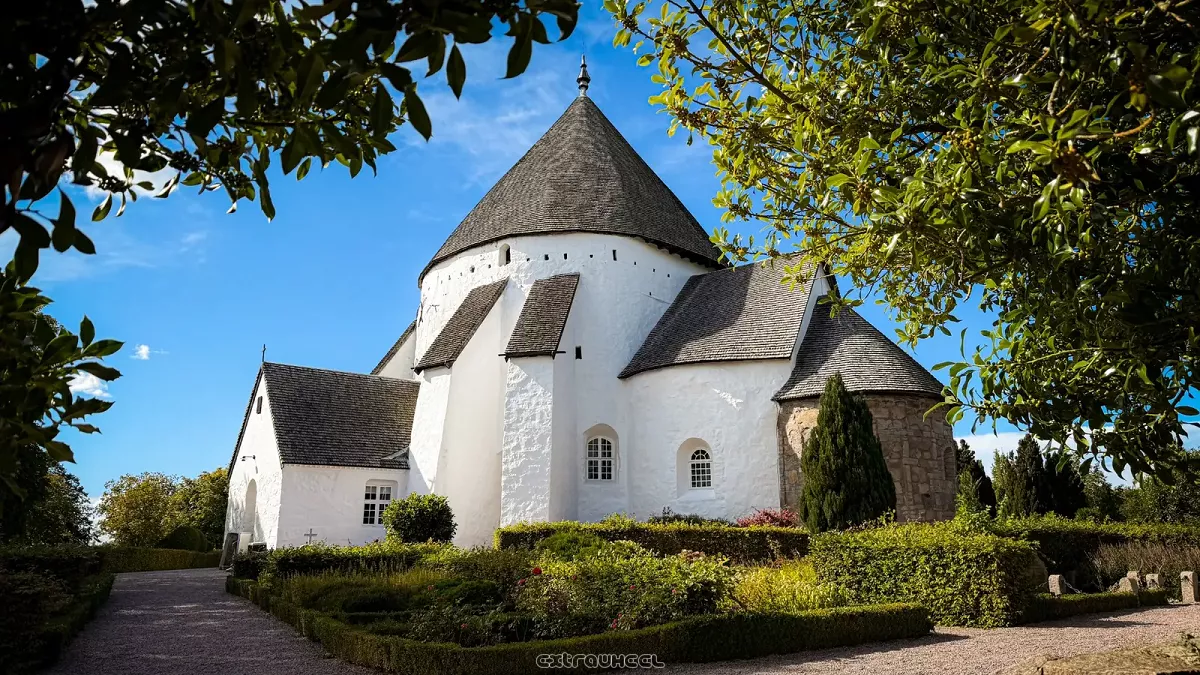
It is also worth leaving coastal Route 10 for a short ride inland. Here stands one of Bornholm’s most characteristic monuments: Østerlars Rundkirke, the largest and best known of the island’s four medieval round churches.
The church was probably built in the 12th century. Its massive cylindrical walls are impressive from the outside, but the interior is even more interesting. The building served not only a religious purpose but also a defensive one: thick walls and several levels allowed it to be used as a refuge during troubled times. Medieval wall paintings survive inside, and a characteristic spiral staircase leads to the upper levels.
Hammershus and Østerlars are only the beginning of Bornholm’s historical story. Across the island you will find medieval churches, old fortifications, historic windmills and small towns where the past always feels close. When planning the loop, it is therefore worth leaving some extra time for sightseeing.
What to eat on the route – food on Bornholm
Sometimes it is worth leaving the main route for a while. On Bornholm, one such detour leads directly to Gudhjem, one of the island’s most distinctive towns.
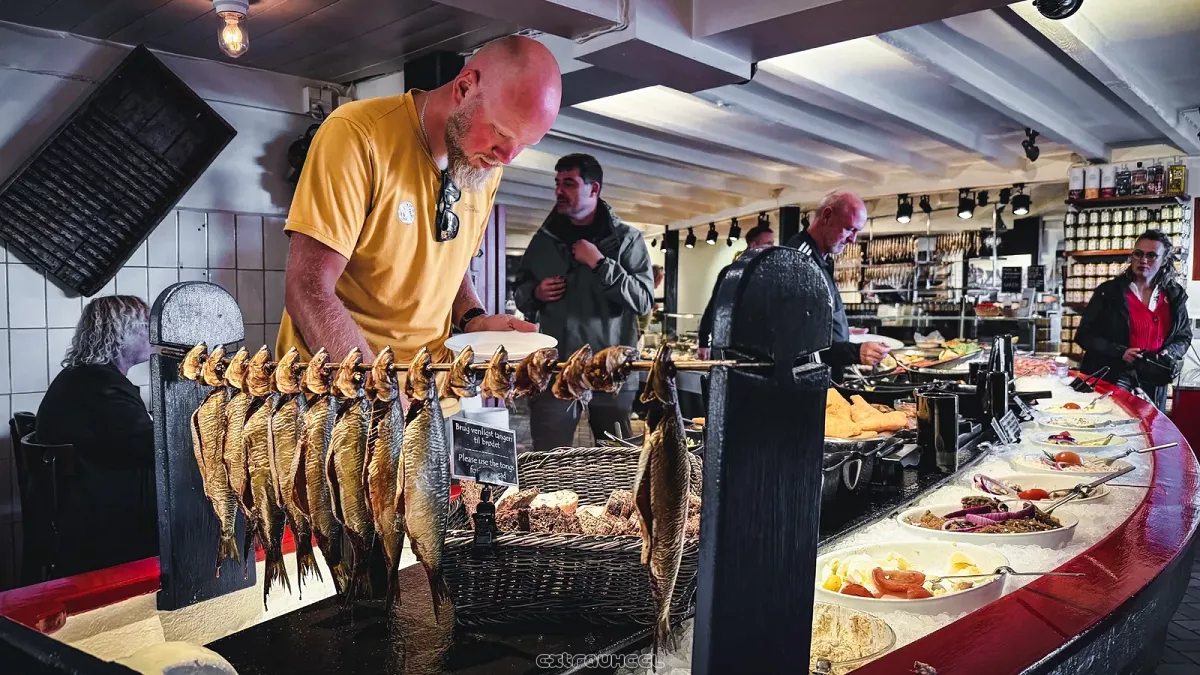
Gudhjem Røgeri, a traditional fish smokehouse, operates here, and its chimney and aroma of smoke are hard to miss. It stands directly beside the coast, so a cycling break can be combined with a view of the Baltic Sea.
The fish is prepared traditionally in wood-fired ovens. Smoking is one of Bornholm’s culinary symbols, and Gudhjem is among the best places to try local specialities in their classic form.
There are several options. If time is short, buy fish to take away and continue the ride. You can also order from the menu, while seriously hungry cyclists may consider the full feast: pay once and the buffet is yours. Build your own meal from different fish, seafood and accompaniments – without a limit.
The selection may include herring prepared in several ways, smoked mackerel, prawns and bread. After a few hours of riding, it tastes particularly good when eaten with a view of the sea.
Gudhjem is worth visiting for more than its smokehouse. The town is known for its position on a rocky coast, its small harbour and its characteristic architecture. It is one of those places where it is good to take a longer break, put the bicycle aside and simply enjoy the island.
Wild camping? Yes, but with restrictions
Bornholm is also a good destination for cyclists who like to sleep close to nature. However, Denmark does not have the Swedish or Norwegian Allemansrätten, the right of public access that permits more freedom to camp in the countryside.
You cannot simply pitch a tent wherever you find a suitable spot. This does not mean giving up a night under the stars: Bornholm has designated places where travellers can stay legally.
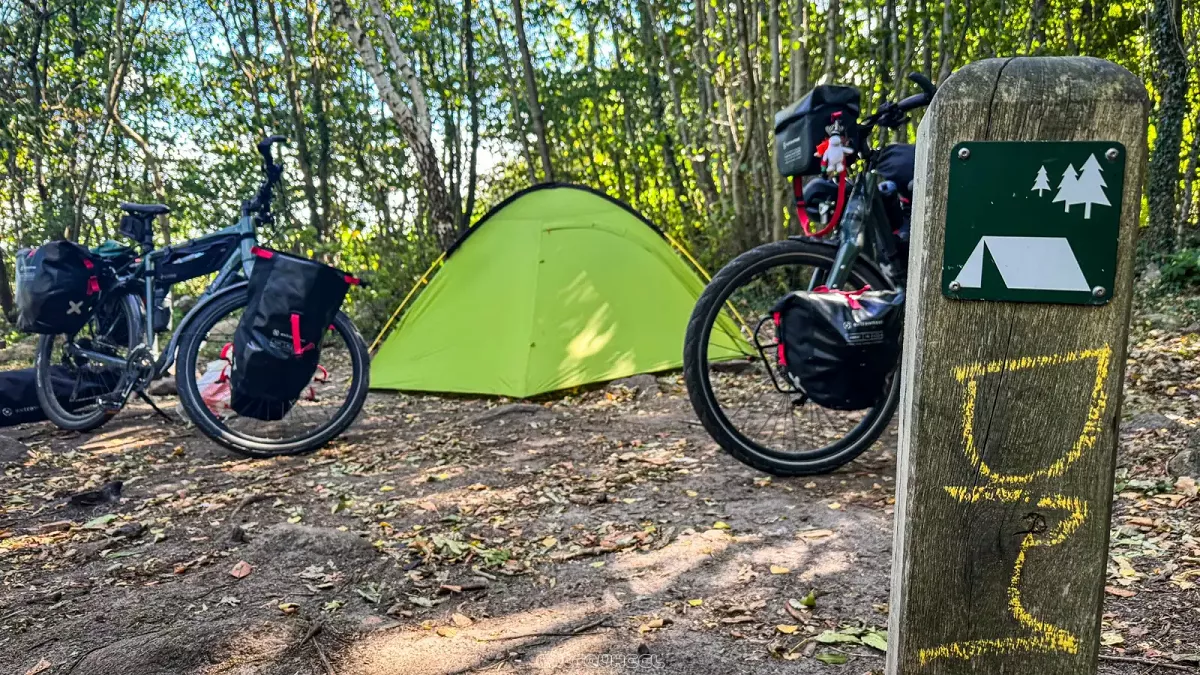
Particularly characteristic are the shelters – simple wooden structures that provide protection from rain and wind. Depending on the location, there may also be designated campsites and zones where tents are permitted.
For cyclists, this is a very convenient solution. You do not need a large campsite or a hotel booking, and the overnight stay becomes part of the adventure itself. Remember, however, that these places are not reserved for people travelling by bicycle. Hikers and other visitors use them too, so in high season it is best not to arrive late in the evening.
Before setting off, check the current map of shelters and camping areas on Bornholm and the rules for the location you intend to use. Facilities vary, including access to drinking water, toilets and permission to pitch a tent.
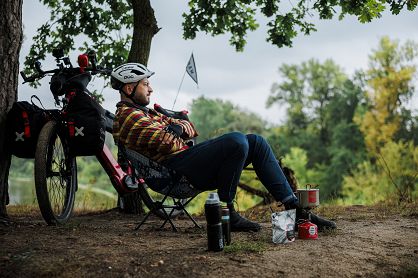
And a morning on Bornholm? Coffee in front of a shelter, panniers on the bicycle and the Baltic behind you – it is difficult to imagine a better start to the next stage.
What to take to Bornholm – pack your bicycle panniers
Bornholm does not require expedition equipment. Shops, restaurants and places to replenish supplies are available along the route, so there is little reason to burden the bicycle with several days’ worth of food unless you want to reduce costs.
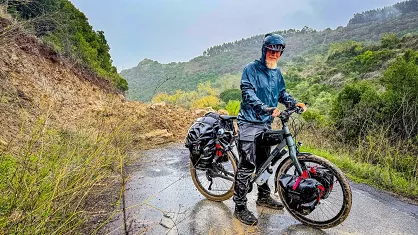
For a two- to four-day tour with panniers, keep the load light and as compact as possible. Clothing for changeable weather is essential, particularly a lightweight windproof jacket and an extra layer for a cooler evening. Near the sea, wind can significantly alter the perceived temperature.
Add water, snacks, sunscreen and sunglasses. If you intend to sleep in shelters or camp, you will of course need a tent, sleeping bag and mat.
Bear in mind that the first part of Route 10 is the most demanding. It includes gravel and forest sections as well as gradients reaching 22%. A lighter load makes a noticeable difference.
A sensible approach is to divide equipment between the panniers: clothing and sleeping gear in one, and cooking equipment, toiletries and other items in the other. Position the heaviest objects as low as possible and close to the bicycle’s centre of gravity.
On Bornholm, thoughtful packing matters more than carrying everything “just in case”. With a well-planned route, supplies can be replenished every few dozen kilometres. Instead of transporting unnecessary weight, leave room for a souvenir, a local delicacy or… another bottle of water.
For more practical advice on arranging your equipment, see our guide to packing bicycle panniers properly.
Which panniers and bags did we take to Bornholm?
A tour with a tent and nights close to nature requires more equipment than a day ride. Besides clothing and food, you need sleeping gear and items used during stops. On both bicycles, we therefore distributed the load between front and rear panniers, handlebar bags and dry bags.
In changeable weather, waterproof bicycle panniers are particularly useful. They let you separate clothing and sleeping equipment from cooking gear and food, while protecting the contents from rain, mud, moisture and road dirt.
Luggage setup on two bicycles
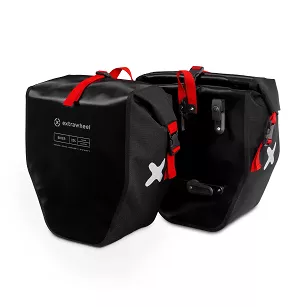
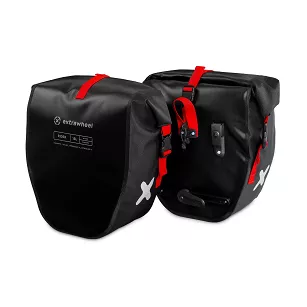
Each bicycle carried a pair of black Biker 50 L rear panniers and a pair of black Rider 30 L front panniers. In total, we used two Biker sets and two Rider sets.
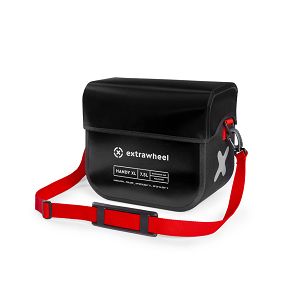
Each handlebar was fitted with a black Handy XL 7.5 L handlebar bag. These held items we wanted to reach without opening the main panniers, including documents, snacks, small electronics and equipment needed during stops.
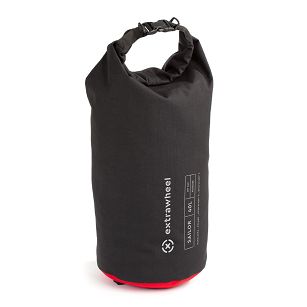
Black Sailor 40 L dry bags secured to the rear racks provided additional space. They were useful for carrying bulkier camping equipment.
This arrangement distributed the larger load between the front and rear of each bicycle and helped balance the weight. The priority was to keep heavier objects low and load the right and left sides to a similar degree.
All the luggage was black, giving both bicycles a coherent appearance. More important, however, were easy access to equipment, pannier stability on uneven surfaces and protection from the island’s changeable weather.
Summary
Bornholm is an island that is exceptionally rewarding to explore from a bicycle saddle. It can be crossed in a single day, but dividing the tour into several stages is a much better idea, leaving time for beaches, historic sites, harbour towns and local food.
Along the way, Bornholm reveals many different faces: the rocky northern coast, forests and cliffs, calmer southern beaches, agricultural landscapes and small towns with a strong local character. Plan stops at Hammershus, Jons Kapel, Gudhjem and Dueodde beach. Most of the route is asphalt, although gravel and forest sections also occur.
This is not merely an easy leisure ride. The northern and eastern parts of the island can surprise you with climbs, and the wind may become another opponent. In return, Bornholm offers an exceptionally well-prepared cycling destination that can suit both a relaxed family tour and a more sporting ride.
Bornholm is best enjoyed without rushing. Instead of simply counting kilometres, stop at a harbour, walk down to a beach, try smoked fish or ride a few kilometres inland. This combination of cycling, nature, history and local life is precisely what makes Bornholm a place worth returning to.
Bornholm by bike – route at a glance
- Start and finish: Rønne
- Route: Rønne – Allinge-Sandvig – Gudhjem – Østerlars – Svaneke – Fyrvejen – Rønne
- Length of our version: 122.1 km
- Length of the official Bornholm Rundt route: 104.5 km
- Surface according to the authors: approximately 78% asphalt, 14% unpaved roads and 8% other paved surfaces
- Elevation gain: approximately 800 m
- Riding time: 2 days
- Difficulty: 3.5/5 – the authors’ subjective assessment
- Route 10 signage: 4/5 – the authors’ subjective assessment
- Recommended bicycle: trekking, gravel or touring bike; an MTB is also suitable
- Facilities: benches, covered rest areas, shelters and designated camping areas
- How to get there: travel to Ystad and take the Ystad–Rønne ferry; other connections may operate depending on season and timetable
Bornholm by bike – frequently asked questions
How long is Cycle Route 10 on Bornholm?
The official Bornholm Rundt loop is 104.5 km long. The version presented in this article covers 122.1 km because it includes additional rides to attractions outside the main course of Route 10.
How many days do you need to cycle around Bornholm?
The route can be completed in one day at a sporting pace. Allow at least two days for a tour with sightseeing; three or four days provide more time to explore the attractions, beaches and harbour towns.
What type of bicycle is best for Bornholm?
A trekking, gravel or touring bicycle with tyres suitable for gravel is the most versatile choice. An MTB also works well. On a road bike, it is sensible to bypass some unpaved sections by using parallel asphalt roads.
Can you camp on Bornholm?
Yes, but only where camping is permitted. The island has designated camping areas, zones where tents may be pitched and wooden shelters. Check the current rules for your chosen location before travelling.
Authors: Aleksandra and Daniel Sienkiewicz – Loverowi. Bicycle travellers, vloggers and guidebook authors. They prepared the journey report, route description and photographs used in this article from their own ride around Bornholm. They publish more trips on the Loverowi YouTube channel and the Loverowi Facebook page. You can also watch their film about cycling around Bornholm.
Check practical information about the official route, ferry services and camping locations again before travelling, as timetables and local rules may change.
 Polish
 German
 French